The Merkaba: the chariot of light
It is depicted as two interlocking pyramids spinning around the body: a "vehicle of light" for travelling between dimensions. The image is recent. Its origin goes back to one of the most mysterious visions of the Bible — and to a tradition of inner ascent.
On the banks of a river in Babylonia, around 593 BCE, an exiled priest named Ezekiel sees the heavens open.
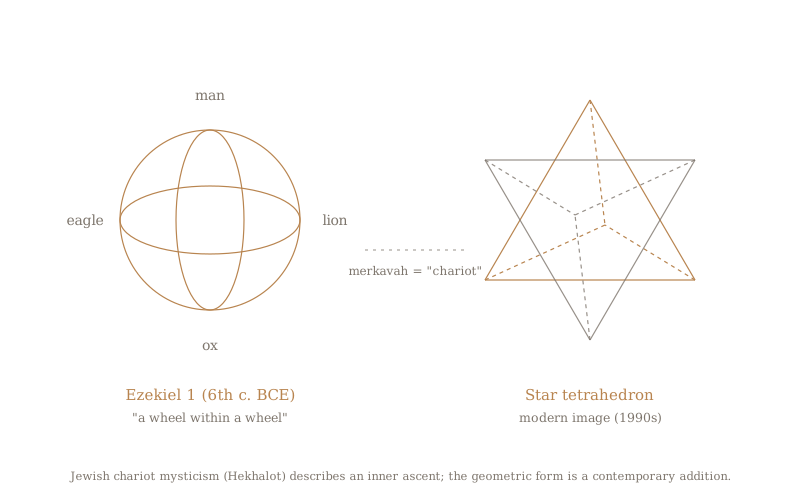
A stormy wind comes out of the north, a great cloud, a fire turning in on itself. In its midst, four living creatures, each with four faces: a man, a lion, an ox, an eagle. Beside them, gleaming wheels, "as it were a wheel in the middle of a wheel", covered with eyes. Above, a crystal vault, a sapphire throne, and on the throne a human form surrounded by a rainbow light (Ezekiel 1).
The rabbis called this vision the merkavah — the "chariot". And for more than a thousand years, mystics sought to relive it.
The mysticism of the chariot
Between the first centuries of our era and the early Middle Ages, Jewish mystical circles produced an astonishing literature, the Hekhalot ("palaces") texts. They describe an inner journey: through fasting, prayer, the repetition of sacred names and concentration, the mystic rises through seven heavenly palaces guarded by angels, until contemplating the Throne.
A fascinating detail: these mystics called themselves the yordei merkavah, "those who descend to the chariot". You would expect "ascend". Scholars still debate the expression. One common reading: the path to the highest runs through a descent into oneself.
The rabbis considered this practice dangerous. The Talmud tells of four sages who entered the "Pardes" (the orchard, an image of contemplation): one died, another lost his mind, a third lost his faith; only Rabbi Akiva "entered in peace and left in peace". The message is clear: you do not rise without preparation.
The modern Merkaba
One of the books of this journey presents the Merkaba as a "body of light", a "vehicle of ascension", and breaks down its name: Mer = light, Ka = spirit, Ba = body.
This breakdown and the image of the star tetrahedron — two triangular pyramids interlocked, one pointing up, the other down — come mainly from New Age teachings spread in the 1990s, notably by Drunvalo Melchizedek (The Ancient Secret of the Flower of Life). They do not belong to the Jewish tradition.
The etymology deserves a clarification. Ka and Ba are indeed two real notions of ancient Egypt: the ka is the life force, the double that survives the body; the ba is the personal aspect of the soul, often depicted as a human-headed bird that can leave the tomb and return. Mer, however, does not mean "light" in Egyptian. And merkavah is a Hebrew word, unrelated to these terms.
This blend is not to be scorned. It expresses an intuition that runs across cultures: the human being may have a subtle "vehicle" with which consciousness can travel. We find it in the Egyptian ba flying from the tomb, in Ezekiel's chariot, in the Theosophists' "astral body", in the silver cord linking that vehicle to the sleeping body.
What we can keep
An image of balance. The two interlocking pyramids, one rising, one descending, recall the Seal of Solomon and the Hermetic axiom: as above, so below. Spirit descending into matter, matter rising towards spirit. It is a beautiful figure for meditation.
A lesson in caution. The authentic chariot tradition insists on ethical preparation, inner stability, guidance. It is not a gadget to "activate" in a few minutes. Today's explorers find the same lesson in other words: the guardian of the threshold only lets through those who are ready.
A direction. Descending to the chariot: height is found in depth. The seven palaces of the Hekhalot resemble the layers that the meditation of the observer passes through — and the planes described by the map of consciousness.
Practice: the chariot meditation
A visualisation inspired by both sources, practised sitting or lying down, before an exploration session.
- Stability. Three minutes of coherent breathing: five seconds in, five seconds out.
- The four faces. Call to mind four qualities in turn: the human (awareness), the lion (courage), the ox (patience), the eagle (perspective). One breath for each.
- The two triangles. Imagine a triangle of light pointing upwards, from your pelvis to your head — what rises. Then a triangle pointing downwards, from your head to your pelvis — what descends. Let them interlock around your heart.
- The chariot. Don't try to make it spin or to leave. Simply rest in this image of balance, as in a vehicle at rest.
- The return. Let the image dissolve. Feel your body on the ground.
If an exit follows, all the better. If not, you will have practised the essential: a stable, balanced, open state.
The chariot only carries those who already know how to stay still.
Further reading
- Ezekiel, chapter 1.
- G. Scholem, Major Trends in Jewish Mysticism, chapter II (Merkabah mysticism).
- Babylonian Talmud, Hagigah 14b — the four who entered Pardes.
This site is free and will remain so. If this content has meant something to you, you can support its creation.
Buy me a lucid dreamvia Ko-fi · 100% to the project