The zodiac man: the sky written in the body
Aries rules the head, Pisces the feet. For centuries, European medicine drew a man covered in the twelve signs of the zodiac. The story of a striking image, what it meant, and what we can keep from it.
Open a fifteenth-century medical almanac. You will almost always find the same image: a naked man, standing, and on each part of his body a sign of the zodiac. A ram on his head, a bull on his throat, twins on his arms, a crab on his chest… down to the fishes under his feet.
This is the zodiac man (homo signorum). One of the books of this journey takes it up, claiming that "Aries rules the upper part of the body" and associating each sign with a "cell salt". The image is historical and beautiful. The second idea is to be set aside.
An image from Antiquity
The correspondence between signs and parts of the body is called melothesia. It is already found in the first century in the Roman poet Manilius, in his great poem Astronomica, then in Ptolemy. It runs through Antiquity, passes through Arab scholars and settles into medieval European medicine.
Its logic is simple: the zodiac begins with Aries, in spring, and the body "begins" with the head. You then go down sign by sign, and part by part, to the feet.
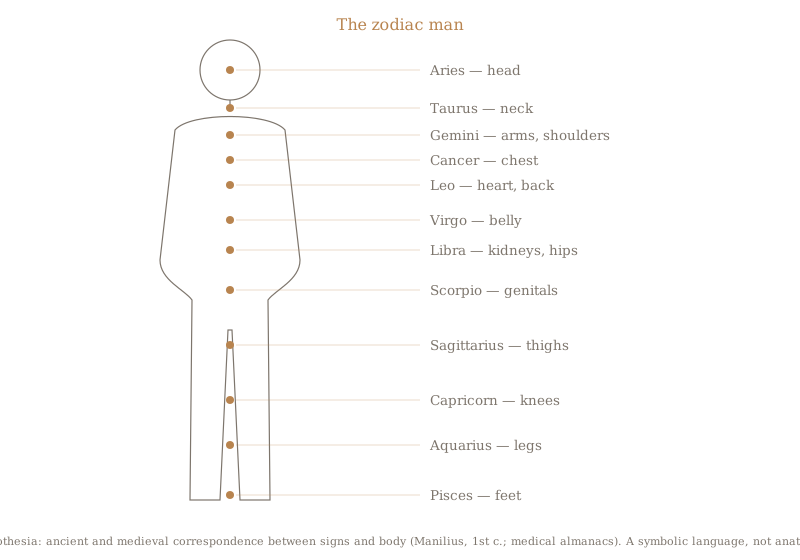
One of the most famous depictions is in the Très Riches Heures du Duc de Berry, an illuminated manuscript from the early fifteenth century: a double figure, front and back, surrounded by the twelve signs, in a blue mandorla.
What was it for?
The zodiac man had a very concrete use: bloodletting, one of the most common treatments of old medicine. It was recommended not to bleed a part of the body when the Moon was passing through the corresponding sign. Almanacs therefore showed, day by day, the position of the Moon and the parts to avoid.
This medicine was wrong in its foundations — bloodletting did more harm than good for centuries. But it expressed a coherent worldview: the human body is a small cosmos, connected to the great one. This is the doctrine of microcosm and macrocosm, at the heart of Hermeticism.
What to set aside
The "cell salts of the zodiac". One of the books associates each sign with a mineral salt the body supposedly needs. This idea comes from "Schüssler salts", a nineteenth-century homeopathic method later linked to astrology. It has no scientific basis, and should not guide diet or treatment.
Astrology as medical science. No rigorous study has shown that the position of the stars at birth or at the time of treatment influences health.
What we keep
A map of attention, from head to feet. Read symbolically, melothesia offers a complete journey through the body, from the crown to the ground. It joins the vertical path of the chakras, but extends it down to the feet, often forgotten.
A poetry of the body. Linking the shoulders to Gemini, the heart to Leo, the knees to Capricorn means seeing each part of the body as carrying a quality: communication in the arms, courage in the heart, perseverance in the knees that carry us. An image, not a diagnosis — but an image that invites you to inhabit your body with more respect.
The link with the Moon. Old medicine watched the Moon. We now know its effects on the body are modest, but real for sleep, as explained in the article on the Moon and the seven planets.
Practice: the zodiac body scan
A ten-minute body scan, done lying down, following the ancient order.
- Aries — the head. Feel the crown, the forehead, the face. Release the jaw.
- Taurus — the neck. The throat, the nape.
- Gemini — the shoulders and arms, down to the fingertips.
- Cancer — the chest. The movement of the breath.
- Leo — the heart and back.
- Virgo — the belly.
- Libra — the hips and kidneys.
- Scorpio — the pelvis.
- Sagittarius — the thighs.
- Capricorn — the knees.
- Aquarius — the calves and ankles.
- Pisces — the feet. Finish by feeling your whole body at once, from head to feet, like a whole sky.
This scan is excellent preparation for stasis, the first step of the protocol: it settles attention in every part of the body before letting it fall asleep.
The sky is not written in your body. But your body can be inhabited with the same attention we give to the sky.
Further reading
- Manilius, Astronomica, 1st century.
- Très Riches Heures du Duc de Berry, folio 14v, Musée Condé, Chantilly.
- J. Tester, A History of Western Astrology, 1987.
This site is free and will remain so. If this content has meant something to you, you can support its creation.
Buy me a lucid dreamvia Ko-fi · 100% to the project