Sacred geometry: flower of life, golden ratio and Platonic solids
The flower of life carved on temples, the golden ratio hidden in shells, Plato's five perfect solids. Sacred geometry has fascinated people for millennia. What is mathematically true is magnificent; what is exaggerated deserves to be said.
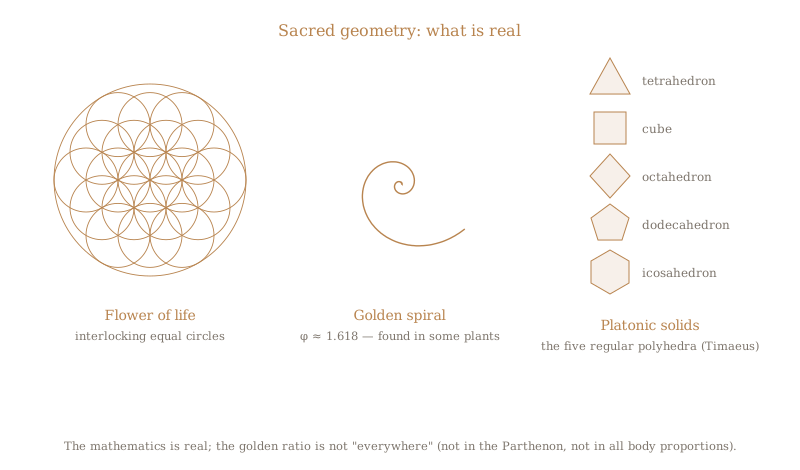
Draw a circle. Then, on its edge, place the point of the compass and draw a second circle of the same size. Continue around the first: six circles fit together perfectly, forming a six-petalled flower. Keep going, and an endless pattern unfolds, regular and harmonious.
This pattern, called the flower of life, appears in many cultures. The books of this journey devote pages to it, as well as to the golden ratio, the Platonic solids, the "geometry of creation". It is a field where the beauty is real — and the legends are many.
What is real
The Platonic solids. There are only five convex regular polyhedra, all of whose faces are identical: the tetrahedron (4 triangles), the cube (6 squares), the octahedron (8 triangles), the dodecahedron (12 pentagons) and the icosahedron (20 triangles). This is not a belief, it is a theorem, proved in Antiquity and set out by Euclid. In the Timaeus, Plato associates four of them with the elements — fire, earth, air, water — and the dodecahedron with the whole universe. In 1596 Kepler even tried to explain the orbits of the planets by nesting these solids. His model was wrong, but his search for harmony led him to the laws that bear his name.
The golden ratio. Written φ (phi), it is about 1.618. It is the ratio such that the larger part is to the smaller as the whole is to the larger part. It is linked to the Fibonacci sequence (1, 1, 2, 3, 5, 8, 13…), in which the ratio between two successive terms tends towards φ. And it really is found in nature: the arrangement of sunflower seeds, pine-cone scales and leaves around a stem often follows Fibonacci numbers. This phenomenon, phyllotaxis, is explained by the most efficient way of distributing growing elements.
Vibration figures. As we saw with Chladni figures, a vibration organises matter into geometric patterns.
What is exaggerated
"The golden ratio is everywhere." No. People look for it in the Parthenon, the pyramids, the Mona Lisa, the ideal proportions of the human body. The mathematician George Markowsky showed in 1992 that most of these claims do not survive measurement: with enough reference points, you can find any ratio anywhere. The famous nautilus shell, often presented as a golden spiral, is not one.
"The flower of life is a code of creation known to the Ancients." The pattern is old and widespread — it is found notably carved on columns of the temple at Abydos in Egypt, at a disputed date, and in Leonardo da Vinci's notebooks. But the idea that it contains secret knowledge about the structure of the universe is recent, popularised by New Age teachings at the end of the twentieth century, the same ones as for the Merkaba.
Why this geometry moves us so
If sacred geometry is not a hidden code, why does it move people so much? Perhaps because it makes something deep visible: the universe is intelligible. Simple laws produce forms of great beauty. A circle and a compass are enough to generate an infinite flower.
That is the intuition Hermeticism expressed: as above, so below. The same proportions appear in the growth of a plant and the organisation of a spiral galaxy, not because an architect hid them there, but because the same laws apply.
The traditions used these forms as supports for meditation: Tibetan mandalas, Indian yantras, cathedral rose windows. Their function is not to transmit information. It is to gather attention towards a centre.
Practice: drawing the flower
A very ancient meditative practice, open to everyone.
- Take a sheet of paper, a compass and a pencil. Put your phone aside.
- Draw a circle in the centre. Breathe.
- Place the compass point on a point of the circle, and draw a second circle. Then continue, slowly, each time placing the point at the previous intersection.
- Let the gesture become as regular as breathing. There is nothing to get right.
- When the six-petalled flower is complete, contemplate it for a minute, attention resting at the centre.
What happens is not mysterious: attention gathers, the mind quietens, gestures become precise. That is exactly the state every meditation — and every exploration — starts from.
Geometry hides no secret. It shows, to anyone who takes the time to look, that order and beauty are born of simple rules.
Further reading
- Plato, Timaeus.
- J. Kepler, Mysterium Cosmographicum, 1596.
- G. Markowsky, "Misconceptions about the golden ratio", The College Mathematics Journal, 1992.
- M. Livio, The Golden Ratio, 2002.
This site is free and will remain so. If this content has meant something to you, you can support its creation.
Buy me a lucid dreamvia Ko-fi · 100% to the project