Music and states of consciousness
"Music is a form of magic," esoteric books say. They are not entirely wrong: it enters us without permission and changes our state. What research confirms, what belongs to myth — and how to use sound as a door.
Some pieces give you chills. Always at the same moment: a rising note, a voice that breaks, a chord that finally resolves. Your skin prickles, your chest opens, sometimes tears come.
You decided nothing. The sound came in, and your state changed.
The two books of this journey devote several pages to this power. They speak of magic, hypnosis, frequencies, words that shape water. Part of what they say is remarkably accurate. Another part does not survive scrutiny. Sorting the two reveals that reality is already extraordinary enough.
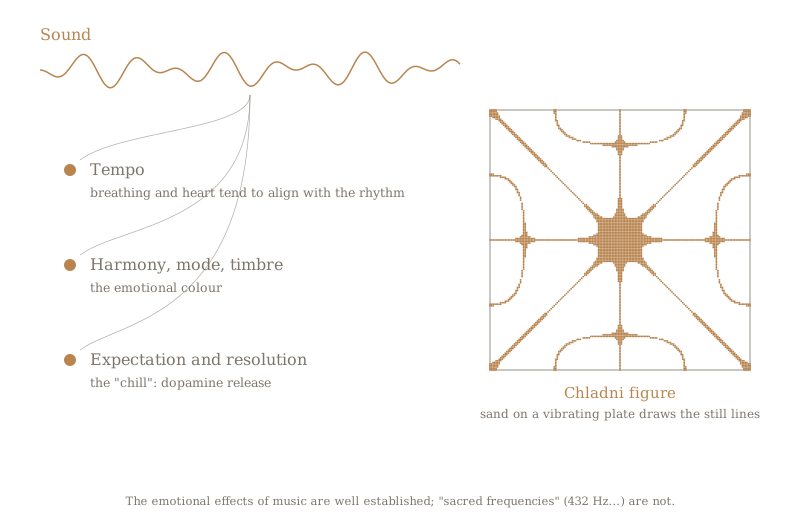
What music really does
It entrains the body. Rhythm has an entraining effect: walking, breathing and, to some extent, heart rate tend to align with the tempo. This is why a drum marches an army, a lullaby puts a child to sleep, and shamanic traditions use steady percussion to induce trance.
It colours emotions. Mode, harmony, timbre, slowness or speed: everyone recognises the melancholy of a slow piano piece or the momentum of a fast rhythm. These effects are among the best documented in psychology.
It plays with expectation. Music creates tensions and resolves them. In 2011 a McGill University team (Salimpoor et al., Nature Neuroscience) showed that musical "chills" come with a release of dopamine in the brain — the same molecule as reward. And this release begins before the peak, during anticipation. The brain enjoys waiting.
So the books are right on one essential point: music changes the state of consciousness. You can speak of a "light trance" when you are absorbed in a piece to the point of forgetting everything else. It is a perfectly ordinary altered state — and a very powerful one.
What needs correcting
Dr Emoto's water crystals. One of the books claims that words like "love" or "hate" written on bottles change the shape of ice crystals. These experiments, widely publicised in the 2000s, have never been reproduced under rigorous controlled conditions: the photographers themselves chose the "beautiful" or "ugly" crystals. It is a lovely image; it is not a fact.
"Sacred frequencies". You read everywhere that music tuned to 432 Hz is "natural" and 440 Hz "harmful", or that certain frequencies "heal DNA". No solid study shows this. Tuning A to 440 Hz is a twentieth-century technical convention, not a conspiracy.
"Dangerous" genres. One of the books accuses certain modern styles of "manipulating the masses". That is a moral judgement, not an observation. What is true is simpler and more useful: all music changes you a little, whatever its genre. The point is not to ban, but to choose consciously.
Chladni figures: seeing sound
There is, however, a real and beautiful experiment that shows the shape of sound.
In 1787 the German physicist Ernst Chladni sprinkled sand on a metal plate, then made it vibrate with a violin bow. The sand flees the vibrating areas and gathers on the still lines. Geometric patterns of striking beauty appear, different for every note. Napoleon, fascinated, funded his research.
In the twentieth century the Swiss physician Hans Jenny extended this work under the name cymatics, filming liquids and powders exposed to sound.
These figures are pure wave physics. They do not prove that words change water. But they offer an accurate and profound image: a vibration organises matter. That is probably why they move those who meditate on the link between sound and spirit.
Sound as a door
Spiritual traditions have all used sound to change state: Gregorian chant, mantras, the syllable Om, Sufi dhikr, Tibetan bowls, the shaman's drum. What they share is not a magic frequency. It is repetition, slowness, and the voice — which engages the breath.
Chanting a long vowel, for example, lengthens the out-breath. And lengthening the out-breath favours the nervous system's recovery mode, as we saw with the guardian of the threshold and the coherent heart. The mantra is not magical; it is physiological — and that is already a great deal.
For the explorer of consciousness, music can accompany three moments:
- before: calming the nervous system and setting the starting emotional state;
- while falling asleep: a steady sound without words, as an anchor point (see the hypnagogic threshold);
- on returning: a piece that helps you come back gently and note what you experienced.
Practice: conscious listening
Once a day for a week, choose a five-minute piece without words.
- Lie down or sit, eyes closed.
- For the first minute, listen only to the rhythm. Feel what it does to your breathing.
- For the second, listen to the harmony: what emotional colour appears?
- For the third, notice the tensions and resolutions: where is your body waiting for something?
- For the last two, analyse nothing. Let the sound pass through you.
- Note in your journal the dominant emotion before and after.
Then try the reverse: five minutes of your own voice, on a single long vowel — ooo or mmm — out-breath after out-breath. Notice the silence that follows. That is often where something begins.
Music does not speak to you. It puts you in the state where you can hear.
Further reading
- V. N. Salimpoor et al., "Anatomically distinct dopamine release during anticipation and experience of peak emotion to music", Nature Neuroscience, 2011.
- E. F. F. Chladni, Entdeckungen über die Theorie des Klanges, 1787.
- H. Jenny, Cymatics, 1967.
This site is free and will remain so. If this content has meant something to you, you can support its creation.
Buy me a lucid dreamvia Ko-fi · 100% to the project