The coherent heart: from symbol to measurement
Every tradition places the heart at the centre of being. Physiology has found in it its own network of neurons, a constant dialogue with the brain, and a rhythm that settles when we breathe a certain way. What is measured, what is told, and what is practised.
We say "heavy-hearted", "wearing your heart on your sleeve", "taking something to heart". We never say "heavy-brained".
Language has always known it: when an emotion runs through us, we feel it first in the chest. Traditions made the heart the centre of being. In the Tree of Life, the heart is Tiferet, Beauty, at the exact centre of the Tree. On the chakra map, Anahata is the fourth centre — three below, three above. In the Bible, it is "out of the heart" that "the issues of life" flow (Proverbs 4:23).
Recent esoteric books go further: the heart would be more powerful than the brain, the generator of a giant electromagnetic field, an organ that perceives the future — and even, according to some, not a pump. Here too there is truth, exaggeration and error. And what is true is more than enough.
What physiology has discovered
The heart has its own neurons. The heart has an intrinsic nervous network — clusters of neurons located in the tissue around it, estimated at around 40,000 in humans. This network constantly adjusts the heart rate, sometimes without waiting for orders from the brain. Some researchers have nicknamed it the "little brain of the heart". The image is strong; it does not make the heart an organ that thinks, but it reminds us that it is not a mere executor.
The heart talks to the brain. The vagus nerve, the main channel of communication between body and brain, carries mostly ascending information — from the body to the brain. The heart therefore constantly informs the brain of its state. And that state changes with emotions: this is one reason an emotion is "felt" in the chest before it is named.
The heart has a measurable magnetic field. True: magnetocardiography records it, and it is considerably stronger than the brain's. But the figures that circulate ("5,000 times", "100,000 times more powerful") do not correspond to comparable published measurements; and the field weakens very quickly with distance. It does not extend "nine metres" around us.
The heart is indeed a pump. An idea inherited from Rudolf Steiner, taken up in one of the books of this journey, claims the opposite: blood would circulate on its own, in spirals, and the heart would merely accompany it. Swirling movements of blood inside the heart's chambers do exist, and they are fascinating. But cardiology, surgery and artificial hearts show every day that the heart propels the blood. The symbol does not need to contradict anatomy to be beautiful.
Variability: the heart is not a metronome
A healthy heart does not beat perfectly regularly. The interval between two beats varies constantly, by a few milliseconds or more. This is heart rate variability. Far from being a defect, it is a sign of flexibility: the nervous system adjusts the rhythm in real time.
What changes with emotions is the shape of this variability.
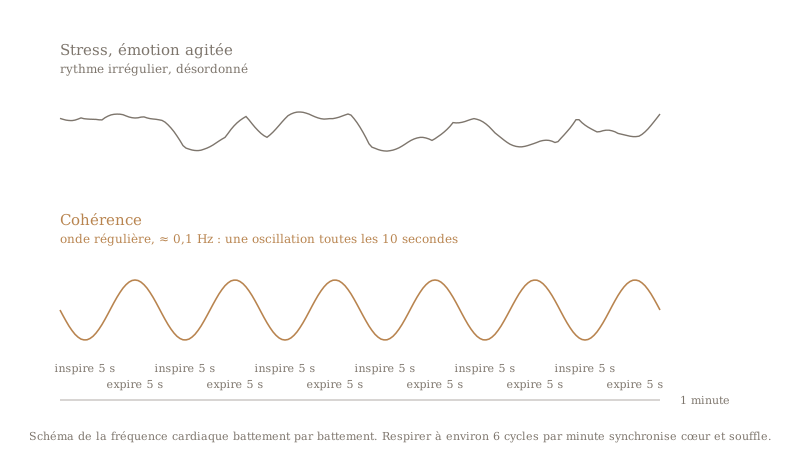
Under stress, anger or anxiety, it becomes disordered. In a state of attentive calm — or when breathing slowly and regularly — it takes the form of a broad, regular wave. This is called cardiac coherence.
Why six breaths per minute? Because in most adults, the system that regulates blood pressure naturally oscillates at around 0.1 hertz — once every ten seconds. By breathing at this rhythm (five seconds in, five seconds out), you enter into resonance with it. Researchers Paul Lehrer and Richard Gevirtz described this mechanism; meta-analyses show a clear effect on perceived stress and anxiety.
In France, the practice was popularised by David Servan-Schreiber in the early 2000s, then by the so-called "365" method: 3 times a day, 6 breaths per minute, 5 minutes.
The heart, crossroads of the emotions
This is where symbol and measurement truly meet.
The books of this journey claim that thoughts produce emotions, that emotions are felt in the heart, and that the quality of this state colours what we "attract". Reworded with care, this gives a proposition anyone can test: your cardiac and emotional state colours your perception, your decisions and the way others receive you. Not by magic: through the face, the voice, the posture, and the way a calm brain thinks more broadly than a brain on alert.
For the explorer of consciousness, this is a first-rate tool. Cardiac coherence:
- shifts the nervous system into recovery mode — what stasis needs;
- widens the window of tolerance, making the encounter with fear easier at the moment of separation;
- sets the emotional state in which you enter the experience — and, as the map of the planes reminds us, what you meet resembles what you carry.
Practice: heart coherence
The basics (5 minutes)
- Seated with a straight back, or lying down.
- Breathe in through the nose for 5 seconds, letting the belly expand.
- Breathe out gently for 5 seconds.
- Continue for 5 minutes. An app or a simple timer can guide the rhythm at first.
The heart version (add it after a week) 5. While breathing, place your hand on the centre of your chest. 6. Imagine the breath going in and out through the heart. 7. Recall a simple memory of gratitude or tenderness — a place, an animal, a face. Don't force the emotion; let it come or not.
Before an exploration session, do this practice lying down, then go straight into stasis. Many practitioners find they enter stillness faster, and that fear at the moment of the vibrations is less intense.
If you feel dizzy, return to natural breathing: the rhythm of six per minute doesn't have to be exact to be effective.
The heart does not command the brain. It sets its tone.
Further reading
- P. M. Lehrer & R. Gevirtz, "Heart rate variability biofeedback: how and why does it work?", Frontiers in Psychology, 2014.
- I. Goessl, J. Curtiss, S. Hofmann, "The effect of heart rate variability biofeedback training on stress and anxiety: a meta-analysis", Psychological Medicine, 2017.
- J. A. Armour, Neurocardiology, Oxford University Press, 1994.
- D. Servan-Schreiber, Healing Without Freud or Prozac (Guérir), 2003.
This site is free and will remain so. If this content has meant something to you, you can support its creation.
Buy me a lucid dreamvia Ko-fi · 100% to the project