Vital energy and sublimation
Desire is an energy. Many traditions teach that it can be directed, transformed, raised. The books of this journey draw strict rules and spectacular promises from this. What Taoism, yoga and psychology really say — without shame and without dogma.
It is one of the most present subjects in the two books of this journey, and one of the most delicate. They speak of sexual energy as a sacred force, to be "raised up the spine" towards the head, and give sometimes very strict rules — even recommending to "retain one's seed", promising health, magnetism and awakening in return.
The subject deserves better than prudishness and better than excess. It touches something deeply human: the energy of desire, and what we do with it.
Three traditions, one intuition
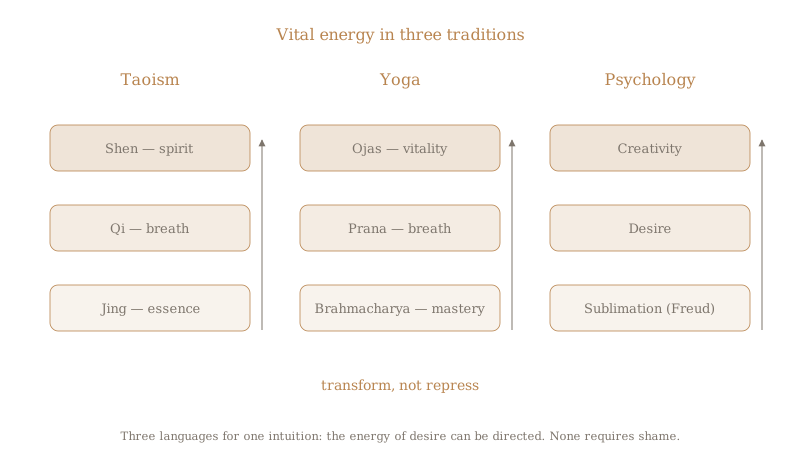
Taoism describes three "treasures": jing, vital essence, associated in particular with fertility; qi, breath; shen, spirit. Taoist inner alchemy teaches to "refine" jing into qi, then qi into shen — a rising of energy, from matter towards spirit. Here we meet again the meridians and the dantian, the centre below the navel.
Yoga speaks of brahmacharya — often translated as "continence", but with a broader meaning: right measure, mastery of the senses, conduct oriented towards what matters. Some texts link this mastery to ojas, a form of subtle vitality. Tantra, often caricatured in the West, is first of all a path that uses every energy, including desire, as material for awakening.
Psychology gave this intuition a name: sublimation. Freud, as early as 1905, described the capacity to transform the energy of drives into artistic, intellectual or social creation. The concept has been debated and refined since, but the general idea remains illuminating: desire is not only to be satisfied or repressed; it can feed something else.
What to set aside
The books of this journey go much further, and several claims must be clearly set aside.
"Retaining one's seed" would make one stronger, healthier, more magnetic. No study demonstrates any notable physical benefit of prolonged abstinence in men. The promises circulating on this subject online belong to marketing or belief. Choosing a period of continence can have personal, spiritual or relational meaning; it is not a health recipe.
Sex would create "astral contracts" binding partners until a ritual breaks them, and one could "summon a soul" by ritual at conception. These are unverifiable beliefs that can feed fear or guilt.
Shame about desire. Several passages present sexuality as the expression of the "lower self", almost of the devil. This is the opposite of what this site seeks. Shame has never made anyone freer. The work on shame shows it: shame imprisons.
What we keep
Desire is an energy, and energy can be directed. Everyone has seen it: a surge of love can carry a work of art, frustration can turn into a run, passion into a project. That is the simplest and truest meaning of sublimation.
The body is where the work happens. Traditions that speak of "raising energy" use very concrete means: breathing, attention brought to the lower body then to the spine, posture. Here we find again the path of attention of the article on the chakras.
Relationship matters. The books insist on respect, love and intention in sexuality. On this point they meet a shared truth: sexuality lived in consent, trust and tenderness nourishes life instead of diminishing it.
Link with awakening and exploration
In alchemy, lead does not become gold by being thrown away. It is transformed. The energy of desire follows the same logic, which is why this step comes before inner alchemy in this journey.
For consciousness exploration, a practical note: states of strong arousal or strong frustration agitate the nervous system. A session of the protocol goes better in calm than in tension, whatever its source.
Practice: the rising breath
A simple, non-sexual practice inspired by Taoist and yogic exercises.
- Sit with your back straight, feet on the floor.
- Bring your attention to the lower belly, below the navel. Three slow breaths.
- On the in-breath, imagine energy gently rising along the spine, from the pelvis to the top of the head.
- On the out-breath, let it come back down the front of the body to the belly. This is the circuit the Taoists call the "microcosmic orbit".
- Do nine cycles. Finish with your hands resting on your belly.
Observe: often a feeling of warmth, of gathering, of calm vitality. An energy neither repressed nor scattered, but inhabited.
We do not rise by despising what lives below. We rise by giving it a direction.
Further reading
- S. Freud, Three Essays on the Theory of Sexuality, 1905.
- Patanjali, Yoga Sutras, II.38 (brahmacharya).
- I. Robinet, Taoist Meditation, 1979 (English trans. 1993).
This site is free and will remain so. If this content has meant something to you, you can support its creation.
Buy me a lucid dreamvia Ko-fi · 100% to the project