The ego is not the enemy
Many spiritual teachings talk about "killing the ego". The books of this journey even make it the inner devil. Research and the best teachers say something else: the ego is a valuable tool, as long as you don't mistake it for yourself.
"The lower self", "the devil", "the serpent", "the beast": the two books of this journey are not gentle with the ego. They describe it as the part of us that seeks pleasure, power and recognition, and that pulls us away from our divine nature. It should be mastered, even eliminated.
This view is widespread in contemporary spirituality. It contains some truth — and a trap. For one can easily build a spiritual ego, proud of its detachment, that looks down on other people's egos.
What we call "ego"
The word has several meanings, and that is the source of much confusion.
- In psychoanalysis, for Freud, the Ego is the agency that arbitrates between drives, prohibitions and reality. Without it, no life is possible.
- In everyday language, ego means pride, the need to be right.
- In spiritual traditions, it is identification with a self-image: "I am my name, my story, my opinions, my body".
It is this last meaning that matters for awakening. And over the past twenty years it has received unexpected light from science.
Two ways of being oneself
Neuroscience roughly distinguishes two modes.
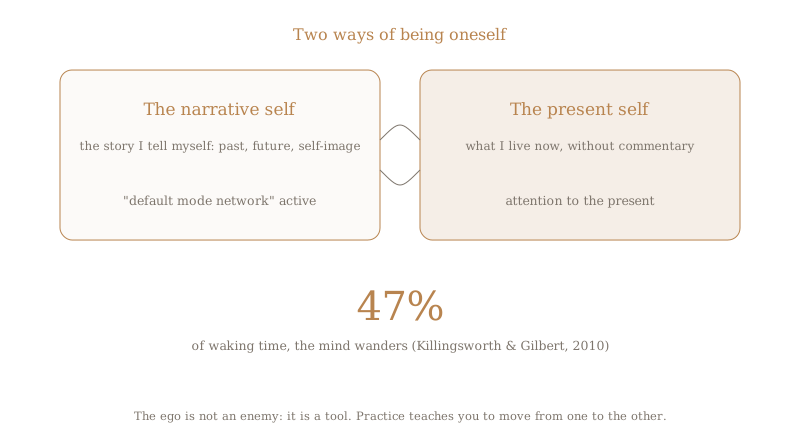
The narrative self. The voice that comments, remembers, anticipates, compares, tells itself a story. It is associated with a set of brain regions called the default mode network, active when we are not doing anything in particular — when the mind wanders.
The present self. The direct experience of what is here, now: sensations, sounds, breath, without commentary.
In 2010 two Harvard researchers, Matthew Killingsworth and Daniel Gilbert, questioned thousands of people at random moments of their day through an app. The result: the mind wanders about 47% of waking time, and people are on average less happy when it wanders than when they are present to what they are doing, whatever the activity. The title of their article in Science: "A wandering mind is an unhappy mind".
Studies of experienced meditators (Brewer et al., 2011) show reduced activity in this default mode network during meditation, and better control when the mind strays.
The ego as a tool
What emerges from all this is not that the narrative self should be "killed". It is indispensable: it lets us plan, remember who we love, learn from mistakes, tell our life. A person with no story of themselves would be deeply lost.
The problem is not the ego. It is exclusive identification with the ego: believing you are this story, and never stepping out of it.
That is what the best teachings say, at bottom. Buddhism does not ask you to destroy the self, but to see that it is not a fixed thing. The meditation of the observer does not remove the layers: it teaches you to set them down and pick them up again. The books themselves say so in a more nuanced passage: it is about "balancing" the higher self and the lower self, not annihilating one of them.
What needs correcting
One of the books describes "three brains" stacked on top of each other — reptilian, limbic, neocortex — corresponding to hell, earth and heaven. This triune brain model was proposed by Paul MacLean in the 1960s. It has since been abandoned by neuroscience: the brain is not a stack of independent layers, but a set of networks working together. The image remains evocative as a metaphor; it is not a description.
As for the idea that the ego is "the devil", it risks feeding shame and self-rejection — the opposite of what a path of awakening seeks.
Link with consciousness exploration
For out-of-body practice, the narrative self plays a precise role: it is the one that, at the moment of separation, exclaims "it's working!" and snaps you straight back into your body. Learning to put it on standby, not to destroy it, is one of the central skills of the protocol.
Practice: naming the narrator
- For one day, each time you notice your mind wandering, say inwardly: the narrator is talking.
- Don't chase it away. Listen to a sentence or two with curiosity: what is it about? past, future, comparison?
- Then return to a present sensation: the contact of your feet, a sound, your breath.
- In the evening, note how many times you noticed it. Not to judge yourself: to see that you can see it.
The one who sees the narrator is not the narrator. That is where freedom begins.
The ego is an excellent servant and a poor master. You don't kill it: you give it back its place.
Further reading
- M. A. Killingsworth & D. T. Gilbert, "A wandering mind is an unhappy mind", Science, 2010.
- J. A. Brewer et al., "Meditation experience is associated with differences in default mode network activity and connectivity", PNAS, 2011.
- L. F. Barrett, Seven and a Half Lessons About the Brain, 2020 — on the abandonment of the triune brain.
This site is free and will remain so. If this content has meant something to you, you can support its creation.
Buy me a lucid dreamvia Ko-fi · 100% to the project