The Tree of Life: the descent and the return
Ten spheres, twenty-two paths, three pillars. The Kabbalistic Tree of Life is one of the most elaborate maps of consciousness ever drawn. How to read it, where it comes from, and what it can illuminate about your own path.
In Genesis there is a man who falls asleep with a stone under his head. Jacob is fleeing his brother; he is alone in the desert. And he dreams of a ladder set on the earth, its top reaching heaven, with angels going up and down on it (Genesis 28:12).
For centuries, Jewish mystics meditated on this image. A ladder: so there are rungs. Angels going up and down: so there is movement in both directions. A ladder set on the earth: so the path begins here, in the body, in daily life.
The Tree of Life is, in a way, the drawing of that ladder.
Where the Tree comes from
Kabbalah — literally "reception", the received tradition — is the mystical current of Judaism. Its roots are ancient, but its major texts span a millennium:
- The Sefer Yetzirah ("Book of Formation"), written between the second and sixth centuries, describes creation through ten sefirot ("numbers" or "emanations") and the twenty-two letters of the Hebrew alphabet. Ten plus twenty-two: the thirty-two paths of wisdom.
- The Bahir, which appeared in Provence in the twelfth century, and then the Zohar, written in Castile at the end of the thirteenth century (traditionally attributed to Moses de León), give the sefirot their names and their symbolic life.
- The diagram as we know it — ten circles linked by twenty-two paths — took shape gradually. One of the first printed depictions appears in Portae Lucis (1516), a Latin translation of a treatise by Joseph Gikatilla. The classic layout was popularised in the seventeenth century by Athanasius Kircher.
From the nineteenth century, the Tree was taken up by Western esotericism (often then called "Hermetic Qabalah"), which linked it to the planets, tarot cards and colours. This blended version is what you find in most modern books. It has its own coherence, but it is honest to know that it is no longer Jewish Kabbalah.
Reading the Tree
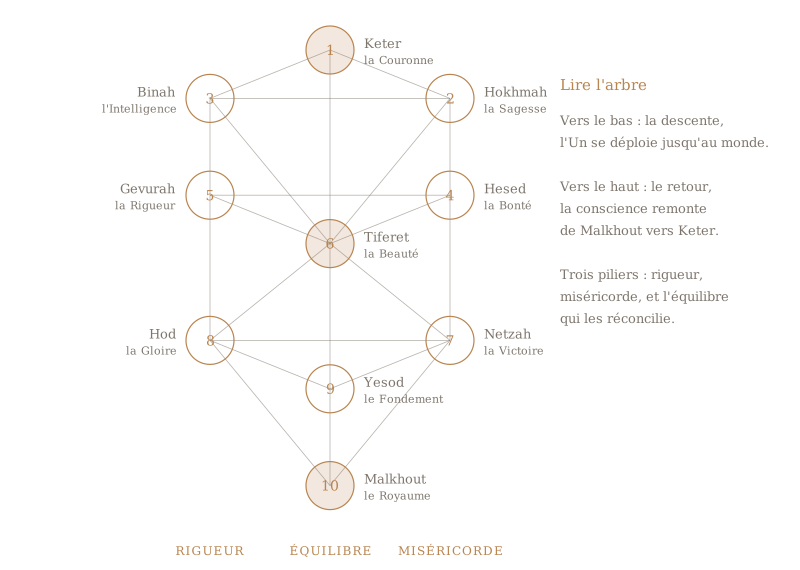
The Tree can be read in two ways.
From top to bottom: the descent. At the summit, Keter, the Crown — the formless origin, what comes before anything. Then Wisdom (Chokhmah), a flash of pure intuition, and Understanding (Binah), which gives that flash a form. Then the qualities of the heart: Loving-kindness (Chesed), Severity (Gevurah), reconciled in Beauty (Tiferet). Then the forces of action: Victory (Netzach), Splendour (Hod), Foundation (Yesod). Finally the Kingdom (Malkhut): the concrete world, the body, here and now.
It is the story of the One unfolding into the many.
From bottom to top: the return. The same path, travelled the other way. You start from Malkhut — you can only start from where you are — and climb, sphere after sphere, towards unity.
It is the story of consciousness remembering its origin.
The three pillars: a lesson in balance
The ten spheres are distributed across three vertical columns.
- The right pillar, mercy: expansion, giving, momentum, love that doesn't count.
- The left pillar, severity: limit, form, discipline, the "no" that protects.
- The central pillar, balance: what reconciles the two.
The lesson is very current. Too much mercy without severity, and everything dissolves: you lose yourself in others, in dreams, in broken promises. Too much severity without mercy, and everything freezes: hardness, control, perfectionism.
The path runs through the centre. And at the centre of the Tree, exactly in the middle, lies Tiferet — Beauty, which tradition associates with the heart. It is no accident that the journey you are reading devotes a whole step to the coherent heart.
The Tree and the explorer of consciousness
Several correspondences directly illuminate the practice of this site.
Malkhut, the starting point. All exploration begins in the body. Traditions that neglect the body produce fragile explorers. This is why the protocol begins with stasis, stillness — Malkhut work.
Yesod, the foundation. In Hermetic Qabalah this sphere is associated with the Moon, dreams, images, what Theosophists call the astral plane. It is the first level above the concrete world — exactly as, on the map of the planes of consciousness, the astral is the first level beyond the physical.
Tiferet, the centre. The balance of the heart, consciousness that observes without being pulled one way or the other. In stackguru's vocabulary: what observes.
Keter, the horizon. What cannot be reached by effort, only approached through silence.
A practice: walking the Tree
You don't need to adhere to a doctrine to use this map. Here is a simple exercise for the evening, in ten minutes.
- Malkhut — Feel your body as it is now. Weight, temperature, tiredness. Without changing anything.
- Yesod — Let the images of the day come. Watch them pass.
- Hod and Netzach — What you understood today (Hod, clarity). What gave you momentum (Netzach, victory).
- Gevurah and Chesed — Where did you set a fair limit? Where did you give without counting? Which of the two was missing?
- Tiferet — Place your hand on the centre of your chest. Let the two poles meet. Breathe slowly.
- Beyond — Stay a few moments in silence, looking for nothing.
Over time, this exercise becomes a kind examination of conscience — and a natural preparation for sleep, and therefore for exploration.
Jacob's ladder was not in the sky. It was set down where he slept.
Further reading
- Genesis 28:10-17 — Jacob's dream.
- Sefer Yetzirah (Book of Formation), several English translations available.
- G. Scholem, Major Trends in Jewish Mysticism, Schocken.
- J. Gikatilla, Gates of Light (Sha'arei Orah); Latin ed. Portae Lucis, Augsburg, 1516.
This site is free and will remain so. If this content has meant something to you, you can support its creation.
Buy me a lucid dreamvia Ko-fi · 100% to the project