The nervous system, guardian of the threshold
Traditions speak of a guardian standing at the entrance to the inner worlds. It has a less poetic name: your nervous system. Understanding how it reacts to fear, stress and difficult memories is the condition for safe exploration.
In almost every initiatory tradition, there is a guardian.
The sphinx before the temple. The cherub with the flaming sword at the entrance to Eden. The "dweller on the threshold" of nineteenth-century occultists, a terrifying figure the aspirant must face before going further. Always the same idea: you do not cross the door of the inner worlds without first meeting what, within you, is afraid.
Modern explorers of consciousness know this moment well. The vibrations rise, the body seems to come loose — and suddenly, a wave of panic. The heart races. A presence seems to be there, in the room. And you find yourself abruptly back in your body, awake, out of breath.
This guardian works in a way we now understand fairly well. Knowing it doesn't make it disappear. But it changes everything about how you meet it.
The brain interprets everything
One of the books this journey draws on rightly reminds us: everything you perceive is an interpretation by your brain. Light becomes image, vibrations of the air become sounds, nerve signals become sensations. The world you live in is a construction — faithful, useful, but constructed.
This construction is largely driven by a part of the nervous system beyond voluntary control: the autonomic nervous system. It has two main modes.
- Activation mode (sympathetic system): the heart speeds up, breathing becomes shallow, muscles tense. This is the "fight or flight" response.
- Recovery mode (parasympathetic system): the rhythm slows, digestion resumes, the body repairs itself. This is the state of rest, and of falling asleep.
To leave your body, the second mode must dominate deeply — this is what the protocol calls stasis. But the slightest danger signal, real or imagined, reactivates the first. And the body comes back online in a fraction of a second.
The guardian is this reflex. It is not your enemy. It is there to protect you.
The window of tolerance
The American psychiatrist Daniel Siegel proposed an image that has become classic: the window of tolerance.
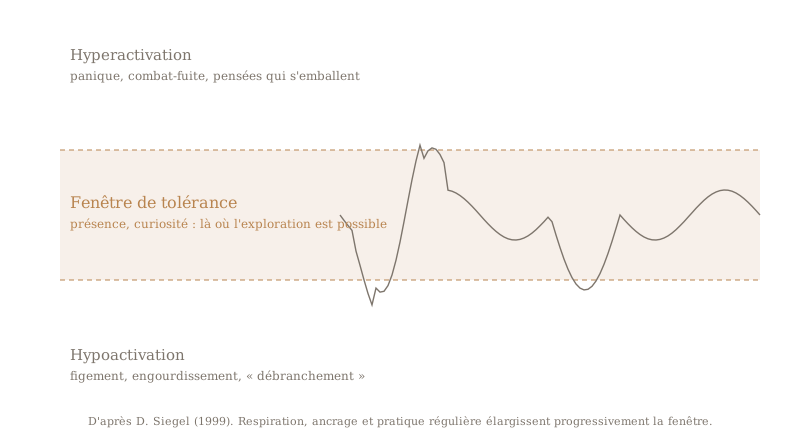
Inside this window, you can feel strong emotions — fear, wonder, strangeness — while remaining present, curious, able to observe. It is the zone where exploration is possible.
Above it lies hyperarousal: panic, racing thoughts, an irresistible urge to move or flee. Below it, hypoarousal: numbness, a sense of emptiness, of being "switched off", sometimes a worrying detachment.
Everyone's window has a different width. It narrows with fatigue, chronic stress, lack of sleep — and with past trauma. It widens with safety, regularity, breathing and training.
Sleep paralysis: meeting the guardian
One phenomenon perfectly illustrates this threshold: sleep paralysis. On waking or falling asleep, consciousness is there, but the body remains in the natural paralysis of REM sleep. You can neither move nor speak. Hallucinations are often added: a presence in the room, a weight on the chest, noises.
It is common. A literature review (Sharpless and Barber, 2011) estimates that about one person in thirteen has experienced it at least once, and more than one student in four. The phenomenon is benign, even if often frightening. Cultures around the world have interpreted it in their own way: the "Old Hag" of Newfoundland, the Japanese kanashibari, the Hispanic pesadilla, the demon sitting on the chest in Füssli's famous painting, The Nightmare (1781).
For the explorer, this is valuable information: sleep paralysis is exactly the bodily state from which an out-of-body experience begins. Body asleep, consciousness awake. What makes the difference between a terrifying experience and a door opening is very often the state of the nervous system — inside or outside the window.
It is also why old books recommend "vibrating high" before projecting. Translated into simple terms: enter the practice calm, not agitated.
The body's memories
The same book stresses another point, on which clinical research broadly converges: difficult experiences leave a trace in the body, not only in conscious memory. A sensation, a posture, a smell can reactivate a fear response without you knowing why.
In deep states — meditation, conscious falling asleep, exploration — these traces can resurface. This is not a failure of the practice. It is often a sign that it is touching something real. But it calls for discernment.
If you have experienced significant trauma, if intrusive memories, anxiety attacks or moments of disconnection appear during or after your practice, it is wise to seek support from a professional trained in trauma (psychologist, psychiatrist, therapist in recognised body-based approaches). Exploring your consciousness does not replace care; the two can move forward together.
Widening your window: five practices
1. The long breath. Lengthening the out-breath (for example breathing in for 4 counts, out for 6 to 8) favours recovery mode. It is the simplest and fastest tool.
2. Grounding through the senses. In a wave of panic, name five things you see, four you touch, three you hear. The brain returns to the present.
3. A safe place. Practise somewhere you feel protected, at regular times. The nervous system loves predictability.
4. The voluntary return. Before each session, remind yourself that you can always come back: move a finger, swallow, open your eyes. Knowing the exit door exists makes the entrance door less frightening.
5. Progression. Don't aim for a full exit in the first week. The protocol's programme begins with two weeks of simple stillness: precisely the time needed to tame the guardian.
Making an ally of the guardian
In initiatory stories, the guardian is not really fought. You recognise it, you hold its gaze, and it steps aside. Sometimes it turns out to be a part of yourself.
This is exactly what the science of the nervous system says, in other words: fear settles when you meet it in safety, gradually, regularly. The courage to go and see is not the absence of fear. It is the ability to stay inside the window while it passes.
The guardian of the threshold does not guard the door against you. It is waiting to know whether you are ready.
Further reading
- D. J. Siegel, The Developing Mind, 1999 — origin of the window of tolerance concept.
- B. A. Sharpless & J. P. Barber, "Lifetime prevalence rates of sleep paralysis: a systematic review", Sleep Medicine Reviews, 2011.
- B. van der Kolk, The Body Keeps the Score, Viking, 2014.
This site is free and will remain so. If this content has meant something to you, you can support its creation.
Buy me a lucid dreamvia Ko-fi · 100% to the project