Intuition and prayer: listening before asking
"Channelling higher wisdom", "the true meaning of prayer": the books of this journey devote several pages to them. What do we know about intuition? What does prayer really do? Precise and sometimes surprising answers.
You have lived this: a decision that seemed reasonable on paper, and yet something in you said no. Discomfort in the stomach, unease in the chest. Later, you understood why.
The books of this journey speak of "channelling higher wisdom" and describe prayer as a way of tuning in to the universal mind. These questions can be approached with a great deal of belief, or a great deal of contempt. There is a third way: looking at what we know.
Intuition: the body often knows before thought
The neurologist Antonio Damasio studied patients with damage to a frontal region of the brain. Their logical intelligence was intact, yet they made disastrous decisions in their lives. His hypothesis, set out in Descartes' Error (1994): we decide partly thanks to somatic markers, bodily signals linked to emotions, which steer our choices before we can even justify them.
So intuition is not magic. It is often bodily knowledge, built up through experience, expressing itself faster than reasoning.
When to trust it?
That is the real question. In 2009 two researchers who seemed opposed in every way — Daniel Kahneman, specialist in errors of judgement, and Gary Klein, specialist in experts' intuition — published a joint article with a telling title: "Conditions for intuitive expertise: a failure to disagree".
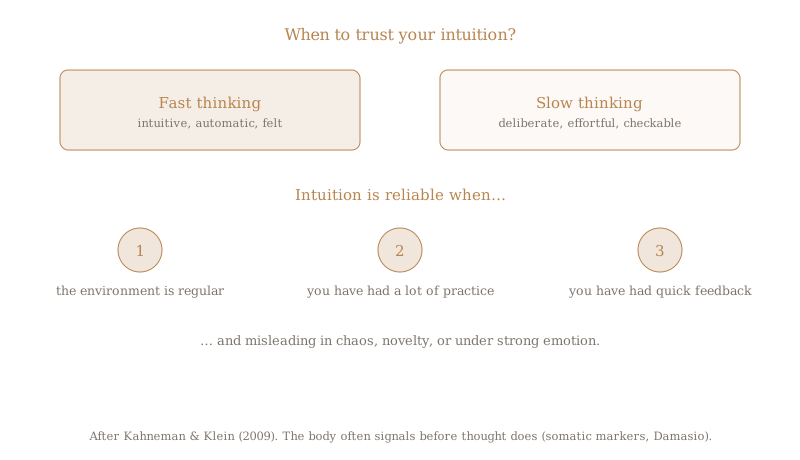
Their conclusion is simple. Intuition is reliable when three conditions are met:
- the environment is regular enough for there to be something to learn;
- you have had a lot of practice;
- you have had quick feedback on your mistakes.
An experienced firefighter who "senses" a floor is about to give way, a nurse who "knows" a patient is getting worse: reliable intuition. An investor who "feels" the market, or someone who "senses" that a stranger is ill-intentioned: much less reliable intuition. And any intuition is distorted by strong emotion — fear, anger, desire.
For the inner explorer, this gives a valuable rule: your intuition about yourself sharpens with practice and honest feedback. That is the point of the practice journal kept in the protocol or in the article on the Moon: without feedback, there is no learning.
Prayer: what science has measured
Prayer is universal. In very different forms, every culture prays.
There is a famous study of intercessory prayer — praying for someone else, at a distance. The STEP study (Benson et al., 2006), carried out on more than 1,800 heart surgery patients, showed no effect of strangers' prayers on their recovery. Strikingly, patients who knew they were being prayed for had slightly more complications, perhaps because of the pressure they felt.
What prayer does to the person praying, on the other hand, is better documented. Contemplative, repetitive, slow prayer — the rosary, the Jesus Prayer of Orthodox monks, Sufi dhikr, mantras — slows breathing, favours cardiac coherence, and calms the nervous system. An Italian study (Bernardi et al., BMJ, 2001) even showed that reciting the Ave Maria in Latin or a mantra slowed breathing to about six cycles per minute — the exact rhythm of coherence.
The "true meaning" according to the books
The books describe prayer as a way of tuning to a frequency, of "speaking to the higher mind" within. Read symbolically, this idea joins the mystical tradition: the highest prayer is not a request, but listening. Psalm 46 says: "Be still, and know that I am God." The hesychasts of Mount Athos spoke of "bringing the mind down into the heart".
What we set aside: the idea that prayer works like an order sent to the universe, guaranteeing a result. Nothing shows this, and the idea can make people feel guilty when their prayer was not "answered".
Practice: the prayer of listening
A practice for believers and non-believers alike.
- Sit with your back straight. Place one hand on your heart.
- Breathe slowly, about five seconds in, five out.
- Inwardly ask one sincere question, about a decision or a difficulty. Just one.
- Then don't look for the answer. Stay ten minutes in silence, attentive to the sensations of the body, especially in the chest and belly.
- Note what appeared: an image, a sensation, a word, or nothing.
- Let at least one night pass before acting, and check this intuition against reflection.
Intuition and reason are not opposed. They are the two hands of the same decision.
Perhaps praying is not speaking louder. It is being silent long enough to hear.
Further reading
- A. Damasio, Descartes' Error, 1994.
- D. Kahneman & G. Klein, "Conditions for intuitive expertise: a failure to disagree", American Psychologist, 2009.
- H. Benson et al., "Study of the Therapeutic Effects of Intercessory Prayer (STEP)", American Heart Journal, 2006.
- L. Bernardi et al., "Effect of rosary prayer and yoga mantras on autonomic cardiovascular rhythms", BMJ, 2001.
This site is free and will remain so. If this content has meant something to you, you can support its creation.
Buy me a lucid dreamvia Ko-fi · 100% to the project