Inner alchemy: turning water into wine
Earth, water, fire, air — and at the centre, the quintessence. Alchemists were not only after gold: many sought to transform themselves. Read as stages of consciousness, the four elements offer a simple method for transmuting an emotion.
Alchemists have a bad reputation. We picture them bent over retorts, trying to turn lead into gold, fools or frauds.
Some were. But reading their treatises, you often discover something else: a laboratory vocabulary that describes, at the same time, an inner transformation. Solve et coagula — dissolve and coagulate. Lead, the heavy, dull metal of Saturn; gold, the solar, unalterable metal. Between them, a long series of operations: burning, washing, distilling, fixing.
In the twentieth century, Carl Gustav Jung spent years on these texts. His conclusion, set out in Psychology and Alchemy (1944): the alchemists projected into their vessels the stages of a psychic process he called individuation — becoming fully oneself.
It is with this key that the two books of this journey reread the four elements. And it is a key that opens directly onto emotional work.
Four roots and a quintessence
The idea that the world is made of four elements goes back to the Greek philosopher Empedocles, in the fifth century BCE. He called them the "four roots": earth, water, air, fire, united by Love and separated by Strife. Aristotle added a fifth element, aether, the incorruptible substance of the stars — the quinta essentia, the quintessence.
Modern chemistry has replaced these four elements with about a hundred kinds of atom. But as a symbolic language, they have lost none of their force. They describe four qualities of experience everyone recognises: density, fluidity, intensity, lightness.
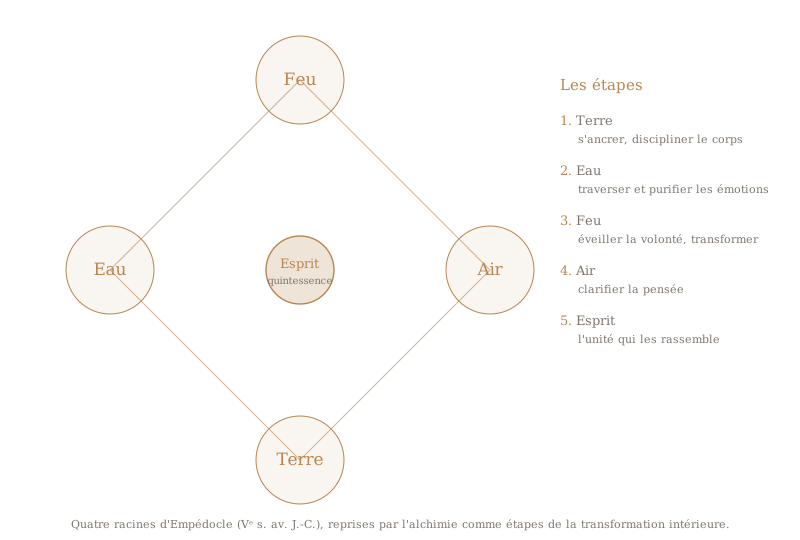
The elements as stages of consciousness
One of the books of this journey proposes a reading found in many esoteric authors: each element corresponds to a stage of inner evolution.
Earth — grounding. The body, matter, needs. On its bright side: stability, discipline, security. On its dark side: raw instinct, attachment to the tangible world alone. It is the starting point, and nothing is built without it.
Water — the emotions. What flows, what overflows, what purifies. Water is the element of feeling. It can drown or cleanse. Traditions associate it with rites of passage — baptism is one example — because you come out of them changed.
Fire — the will. Momentum, passion, transformation. Fire burns what must disappear and gives the energy to move forward. It is the element of active awakening: the desire for truth that drives the search.
Air — clear thought. The subtlest of the four: ideas, understanding, speech. Air rises and sees the whole.
Spirit — the quintessence. What is none of the four and gathers them. The unity at the centre: in this site's language, what observes.
Turning water into wine
The first miracle reported in the Gospel of John (2:1-11) takes place at a wedding in Cana. The wine runs out; Jesus has six stone jars filled with water, and the water becomes wine — a better wine than the first.
For believers, it is a miracle. Many mystical readers have also seen in it an inner image. This is the reading proposed by one of the books of this journey: water is our raw emotions; wine is those same emotions transformed — fear become vigilance, anger become protective strength, sadness become depth.
This reading excludes no other. But it expresses a truth the psychology of emotions confirms: you don't get rid of an emotion, you transform it. An emotion always carries information and energy. Repressing it keeps the water stagnant. Letting it overflow floods everything. Transmuting it extracts what is precious in it.
It is no accident that the jars are made of stone — of earth. Transformation begins in the body.
Transmutation in five steps
Here is a practice that follows the order of the elements. It takes five to ten minutes, and can be used when a difficult emotion is present — or in the evening, for an emotion from the day.
1. Earth — feel it in the body. Where is the emotion? Throat, chest, belly, jaw? Rest your attention there, without trying to understand. Breathe slowly. You are not the emotion: you are the body carrying it, resting on the ground.
2. Water — let it flow. Name it, simply: anger… sadness… shame… fear. Let it be there for a few breaths, without judging or feeding it. A welcomed emotion has a surprisingly short life; it is resistance that prolongs it.
3. Fire — find what it protects. Every emotion defends something. Anger protects a boundary. Fear protects your safety. Sadness honours what had value. Shame signals a need to belong. Ask yourself: what is this emotion taking care of? That is where its useful energy lies.
4. Air — gain perspective. Put the situation into words, as if telling a kind friend. What would a fitting response be, now that you have heard what the emotion had to say? Air brings perspective.
5. Spirit — observe the path travelled. Return to the centre. Notice that you have crossed the four elements, and that something in you remained steady throughout. That steadiness is the quintessence.
The articles on each emotion — anger, sadness, fear, shame — explore each of these passages in depth.
The end of the journey, the start of the voyage
This journey ends here. You have travelled through the law of correspondences, the architecture of the Tree, the map of the subtle body, the guardian of the threshold, the programs, the heart, and now alchemy. They are keys, not doctrines: each opens a door only you can walk through.
The natural next step is the Body and cosmos journey, then The thresholds, and finally the Astral journey. Transmuted emotions, a calm heart and a tamed guardian become the very ground of exploration there.
Lead is not the enemy of gold. It is gold that has not yet remembered what it is.
Further reading
- Empedocles, fragments, in The Presocratic Philosophers (Kirk, Raven & Schofield), Cambridge.
- C. G. Jung, Psychology and Alchemy, 1944.
- Gospel of John, 2:1-11 — the wedding at Cana.
This site is free and will remain so. If this content has meant something to you, you can support its creation.
Buy me a lucid dreamvia Ko-fi · 100% to the project