Who is observing? The meditation of the layers of the self
Your name, your body, your thoughts, your emotions: you say "my" body, "my" thoughts. But who is this "I" that owns them? An ancient practice, found from Vedanta to Buddhism, to rediscover what observes — and the first step of any conscious exit from the body.
You say "my body".
Pause on that phrase for a second. If it is your body, then it is not you — it is something you own, inhabit, use. You also say "my thoughts", "my emotions", "my memories". Each time, the same movement: an "I" that owns, and a thing that is owned.
So who is this "I"?
This is not wordplay. It is one of the oldest and most widespread meditative practices of humanity. And for the explorer of consciousness, it is direct preparation for leaving the body: you cannot consciously leave your body as long as you believe you are that body.
A question that runs through the traditions
In the Upanishads, sages practised neti neti — "not this, not that". You examine everything you identify with and observe: I am not this, since I can observe it. The body is observed: I am not the body. Thoughts are observed: I am not my thoughts.
In the twentieth century, the Indian sage Ramana Maharshi made this approach a daily practice, atma vichara, self-enquiry, summed up in a single question: "Who am I?"
Buddhism approaches the same territory by another path: patiently observing that everything that appears — sensations, perceptions, thoughts — constantly changes, and that none of these elements constitutes a fixed self.
The West has its own version: the "Know thyself" carved at Delphi, and Psalm 46: "Be still, and know that I am God." Christian mystical texts have often read this verse as an invitation to inner silence.
Contemporary esoteric compilations take up this idea in an image: we are said to be covered in layers of sediment — mental programs, conditioning, inherited beliefs — that obscure a pure, unconditioned awareness. Meditation would consist in removing them one by one.
The three circles
A simple representation, found in several teachings, describes meditation as passing through three concentric circles towards a centre.
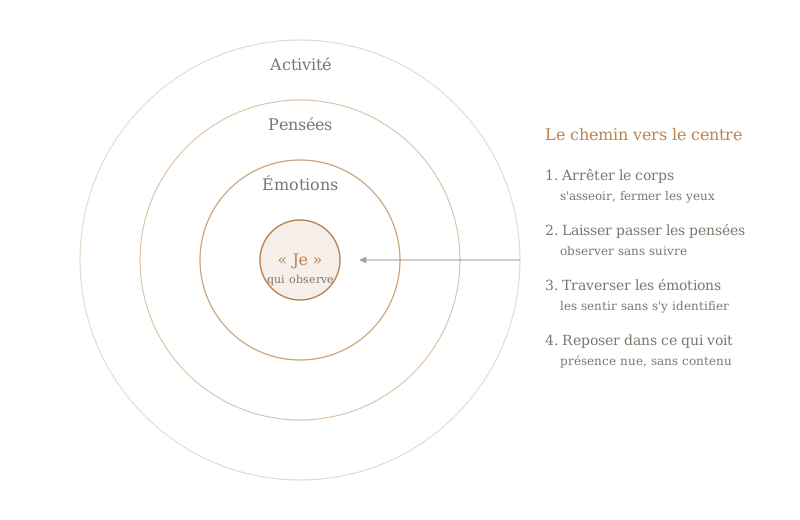
The circle of activity. The easiest to cross: sit down, close your eyes, stop doing. The body stops.
The circle of thoughts. Subtler. You don't chase them away — that is impossible. You simply stop following them. They pass like clouds; you remain the sky.
The circle of emotions. The closest to the centre, and the stickiest. An emotion is not a thought: it is felt in the body, it colours everything. As long as you are in an emotion, you are not really meditating — you are still caught. Crossing it does not mean suppressing it, but feeling it fully without identifying with it: there is sadness, rather than I am sad.
This is why stackguru starts with emotions. Anger, shame, fear are not obstacles to eliminate before the "real" work. They are the last circle before the centre. Whoever has learned to cross them without drowning has done most of the journey.
The centre. What remains when activity, thoughts and emotions pass without being held on to: a bare, silent, contentless presence. The traditions have given it a thousand names. The simplest may be this one: what observes.
The practice: peeling the layers
Here is a guided version of the exercise, adapted from several traditions. Allow twenty to thirty minutes.
1. Settle. Seated, back straight without stiffness, or lying down if you practise before an out-of-body session. Close your eyes. Let the breath settle by itself.
2. Take stock. Mentally list what you identify with. Your first name. Your job. Your body. Your opinions. Your current worries. Your memories. Judge nothing, just notice.
3. Remove the first layer: the name. Ask yourself: if I had been given another name, would I be someone else? No. The name is a label. Set it aside.
4. Remove the role. Your job, your status, your relationships. They change over a lifetime; something in you has stayed the same. Set them aside.
5. Remove the body. Feel your body from the inside. It is perceived: sensations, weight, warmth. What perceives these sensations is not a sensation. Let the body be there without confusing yourself with it.
6. Remove the emotions. Notice what you feel right now. Name it: calm… restlessness… boredom… This too is perceived. This too passes.
7. Remove the thoughts. Watch the little inner voice that comments. Notice that it speaks to someone. Listen to it the way you would listen to a radio in another room.
8. Remove even language. This is the finest layer. Beyond words, something remains — a presence, a clarity, a kind of light without a source. Don't try to define it: defining it is already returning to words.
9. Rest there. As long as you can. When a thought carries you away — and it will — notice it without reproach and return to the centre. Each return is the practice itself.
10. Come back gently. Put the layers back one by one, as if getting dressed. Your body. Your name. Your day. But knowing, from now on, that they are worn and do not define you.
The link with leaving the body
Experienced practitioners all say it in their own way: leaving the body is not a movement, it is a change of identification.
As long as your consciousness is stuck to the idea "I am this body", it stays anchored in its sensations. This is the "glue" the out-of-body protocol talks about — step 4 describes precisely how it loosens. The meditation of the layers works on this glue by day, cold, with no pressure for results. It gets you used to feeling yourself as what observes the body, rather than as the body itself.
The day you lie in the trough of the wave, body asleep, vibrations rising, you won't have to learn this movement. You will have done it a hundred times.
You are not a drop of light lost in a body. You are the light that, for a moment, took the shape of a drop.
We are nothing but light, and light is eternal.
Further reading
- Ramana Maharshi, Who Am I? (Nan Yar?), dialogues from the 1900s.
- Brihadaranyaka Upanishad, II.3.6 — the neti neti formula.
- Psalm 46:10 (46:11 in some numberings).
This site is free and will remain so. If this content has meant something to you, you can support its creation.
Buy me a lucid dreamvia Ko-fi · 100% to the project