The pineal gland, between science and symbol
Seat of the soul for Descartes, third eye for the yogis, target of every theory on the internet. What do we really know about this small gland at the centre of the skull — and what is it worth to the explorer of consciousness?
At the centre of your skull lies a gland the size of a grain of rice, shaped like a pine cone. It belongs to neither hemisphere. It sits alone, in the middle.
It is probably the organ that has prompted more speculation than any other in the history of human thought.
Recent esoteric books describe it in turn as the throne of God, the antenna of the soul, a crystalline eye able to emit light, and the victim of a plot to cut humanity off from its powers. Some of these claims rest on real facts. Others do not. Untangling the two is a useful exercise — and it reveals a gland more interesting than the myth.
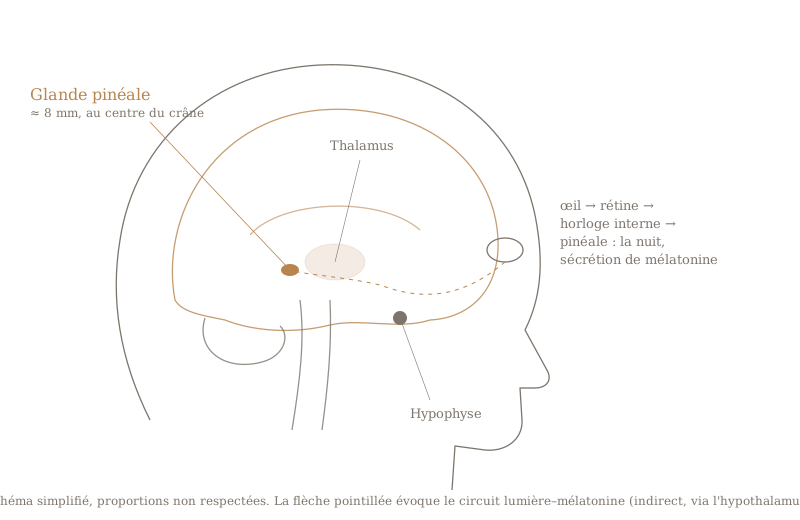
What is established
It produces melatonin. This is its main function. When light fades, the retina informs the brain's internal clock (the suprachiasmatic nucleus of the hypothalamus), which signals the pineal to secrete melatonin — the hormone that tells the body it is night. The pineal is thus, literally, the gland that translates light and darkness into the chemistry of sleep.
For the explorer, this fact alone justifies the interest: all out-of-body work happens in the transitions of sleep, and the pineal is one of their conductors.
It really is related to an "eye". In some reptiles and amphibians — lizards, frogs, the New Zealand tuatara — a related organ, the parietal eye, has a small lens and a rudimentary retina under the skin at the top of the skull. It perceives light. In mammals this organ has sunk into the brain, but the evolutionary kinship is real. The expression "third eye" is therefore not only a metaphor.
It contains microcrystals. In 2002, a French-Israeli team (Baconnier et al., Bioelectromagnetics) described calcite microcrystals in human pineal glands, distinct from the coarser calcifications known for a long time. The authors hypothesised that they might have piezoelectric properties — that is, respond electrically to mechanical stress or to a field. This is a research hypothesis, not a demonstration, and it has not been confirmed since. Books claiming that the pineal "receives and emits frequencies" or "emits light" go far beyond what the study says.
It calcifies with age. In a large share of adults, the pineal accumulates calcium deposits visible on scans. It is a common phenomenon whose clinical meaning is still debated.
What is historical
Descartes, in the seventeenth century, saw it as the point of contact between soul and body. His reasoning was simple: the brain is double, our perceptions are single; there must therefore be a single organ where they come together. The pineal, alone in the centre, was the ideal candidate. Anatomy has since shown that this reasoning does not hold — but the intuition of a "centre" of consciousness has crossed the centuries.
The pine cone is a recurring motif in sacred art: the staff of Dionysus, Assyrian reliefs of winged genies holding a cone, and the huge bronze Pigna that stands in a courtyard of the Vatican. These correspondences are real. The idea, however, that they prove secret knowledge of the gland — and that an institution concealed it — is interpretation, not documented history. The pine cone is also, more simply, a universal symbol of fertility and renewal.
The yogic third eye, ajna chakra, is located between the eyebrows, not at the centre of the skull. Nineteenth-century Theosophists associated it with the pineal; ancient Indian tradition did not. It is a late meeting between two systems, not an original equivalence. Some esoteric texts themselves acknowledge it: the gland would be the physical reflection of a faculty that is not physical.
What is not established — or is false
"The pineal is the seat of consciousness." No data shows this. People whose pineal has been surgically removed (because of a tumour, for instance) remain fully conscious. They often sleep less well — which is consistent with its real role.
"The pineal produces DMT that makes us leave the body." Traces of DMT, a psychedelic molecule, have been found in the rat pineal (Dean et al., 2019). Nothing shows that the amounts produced in humans affect consciousness, or that they play a part in dreams or out-of-body experiences. It is a line of research that has turned into a myth.
"Fluoride calcifies the pineal and cuts us off from our true self." A British thesis (J. Luke, 1997, published in 2001) showed that fluoride can accumulate in the calcifications of the pineal. There is, however, no demonstration that this reduces consciousness, intuition or any spiritual capacity. Science fact-checking organisations consider these claims unsupported.
"A one-fruit diet for a week decalcifies the pineal." No basis. And extreme diets are not harmless.
This sorting takes nothing away from the gland's interest. It simply avoids building a practice on sand.
What the explorer can do with it
Once the myth is removed, three very concrete things remain.
1. Respect the chemistry of the night. The pineal responds to light. Screens in the evening, bright lights and chaotic schedules disrupt melatonin — and therefore the quality of the sleep cycles on which the whole practice of the trough of the wave rests. Real darkness in the bedroom is your first exploration tool. Less spectacular than decalcification, and far more effective.
2. Use the centre of the skull as a point of attention. Many traditions place attention here to stabilise consciousness while falling asleep. Esoteric compilations also recommend it before projection: lying still, gently bring attention to the middle of the head until tingling comes. Whether or not the gland is involved, a fixed, central and calm point of attention is an excellent anchor for staying present while the body falls asleep.
3. Keep the symbol for what it is. The pineal, alone between two hemispheres, is a magnificent image of what the explorer seeks: a point of unity at the centre of duality, an eye that looks inward. A symbol doesn't need to be a proof to be a compass.
The third eye may not be a gland. It may simply be the decision to look inward with the same attention we give the world.
Further reading
- S. Baconnier, S. B. Lang et al., "Calcite microcrystals in the pineal gland of the human brain: first physical and chemical studies", Bioelectromagnetics, 2002.
- J. G. Dean, T. Liu, … J. Borjigin, "Biosynthesis and extracellular concentrations of N,N-dimethyltryptamine (DMT) in mammalian brain", Scientific Reports, 2019.
- J. Luke, "Fluoride deposition in the aged human pineal gland", Caries Research, 2001.
- R. Descartes, The Passions of the Soul, 1649, articles 31–32.
This site is free and will remain so. If this content has meant something to you, you can support its creation.
Buy me a lucid dreamvia Ko-fi · 100% to the project