Out-of-body experiences: what history has kept
A silver cord in Ecclesiastes, a fire seen 400 kilometres away, a wife who crosses the Atlantic in a dream, a woman who leaves her body inside a scanner. What the best-documented accounts really say — and what they don't.
There are two ways to talk badly about out-of-body experiences.
The first is to believe everything. Every testimony becomes proof, every legend a hidden truth, every doubt a sign of a closed mind. The second is to reject everything: whatever does not fit in a laboratory does not exist, and the case is closed before it is opened.
Both attitudes share one thing: they spare us the trouble of looking.
This article does the opposite. It takes some of the most cited accounts in history — the ones that appear in nearly every book on astral travel — and puts them back in their proper place. What is documented. What is reported. What has been criticised. And what you can take from it for your own practice.
The silver cord — a very old image
Almost every astral projection manual mentions a "silver cord" linking the subtle body to the physical body during the journey. It is often presented as a discovery of modern explorers.
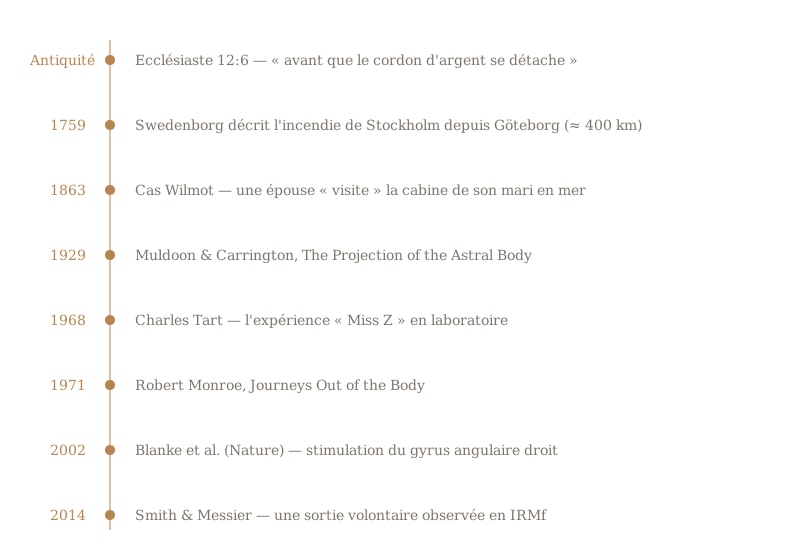
It is in fact much older. It appears in a biblical text, Ecclesiastes (12:6), in a poem about old age and death: "before the silver cord is loosed, or the golden bowl be broken… and the spirit shall return unto God who gave it."
In context, the image refers first to the thread of life that snaps at death. It was the Theosophists of the nineteenth century, and then twentieth-century authors, who made it part of the phenomenology of leaving the body.
What to keep: the intuition of a link between consciousness and body — a link that can stretch without breaking — runs across cultures. Not every practitioner today sees a cord. Many describe instead a "pull", a kind of gravity drawing them back. It is the same intuition in different words — what the out-of-body protocol calls the "glue".
1759 — Swedenborg and the Stockholm fire
Emanuel Swedenborg was no passing visionary. He was one of the most respected scholars of eighteenth-century Sweden: a mining engineer, an anatomist, the author of strikingly advanced work on the brain. In his fifties, he began to describe visions and journeys into spiritual worlds.
In July 1759 he was dining with friends in Gothenburg. During the evening he grew pale and agitated, went out, came back, and announced that a fire was raging in Stockholm — about 400 kilometres away — and threatening his own house. A few hours later he said he was relieved: the fire had stopped three doors from his home.
There was no telegraph, and no messenger could have arrived in that time. News from Stockholm came two days later: the fire had indeed happened, and Swedenborg's details matched.
The episode has one feature that makes it precious: it intrigued Immanuel Kant. The philosopher made his own enquiries and, in a letter published after his death, wrote that this account had in his eyes "the greatest evidential force" of those he had examined. The same Kant nevertheless published Dreams of a Spirit-Seer in 1766, a deeply mocking book about Swedenborg.
What to keep: even a mind as demanding as Kant's could not settle it. The case is still told, still discussed, never fully explained. That is probably the right position: neither proof nor fable.
1863 — The Wilmot case, a visit in mid-ocean
This is one of the most famous cases in psychical literature, published in 1891 in the Proceedings of the Society for Psychical Research, the British learned society founded to study such phenomena.
In October 1863, an American manufacturer, Mr Wilmot, was crossing the Atlantic from Liverpool to New York. A storm shook the ship for nine days. On the eighth night he dreamed that his wife, who had stayed in the United States, came into his cabin in her nightdress, hesitated on seeing that he was not alone, then came over and kissed him.
When he woke, his cabin companion, a man named Tait, looked at him knowingly: he had seen, awake, a woman come in and kiss Wilmot.
Back home, Wilmot learned that his wife, anxious about the storm, had that night felt herself cross the sea, find the ship, enter the cabin — and hesitate on seeing a man lying in the upper berth. She described the ship, which she had never seen.
What the critics say: the case has been closely examined, and it has weaknesses. Almost the entire account comes from Mr Wilmot himself, collected twenty-six years later. Tait had died before the enquiry. One researcher, Susan Blackmore, concluded that the case "does not bear close scrutiny". A more recent hypothesis suggests another passenger may have entered the cabin by mistake.
What to keep: the story features an element many practitioners recognise today — emotion as a driving force. Mrs Wilmot did not "decide" to travel. She was anxious, reaching out towards someone she loved. Whether one sees a real projection, a coincidence or an after-the-fact construction, the structure of the story says something: where emotionally charged attention goes, consciousness tends to follow.
1929 — Muldoon and Carrington: the first modern manual
Sylvan Muldoon was a young American who had experienced spontaneous projections since adolescence. With Hereward Carrington, a psychical researcher of the time, he published The Projection of the Astral Body in 1929.
It was the first book to treat leaving the body as a technique rather than a gift or a miracle. It already stresses the importance of the falling-asleep phase, the role of desire and intention, and the use of thirst (going to "fetch a glass of water" in a dream) as a trigger.
What to keep: the idea that projection is a skill you can train — the founding idea of stackguru — is almost a century old.
1968 — Charles Tart and "Miss Z"
Charles Tart, a psychologist at the University of California, met a young woman who claimed to leave her body almost every night. He invited her into the laboratory for four nights. She slept wired to an electroencephalograph. On a high shelf, invisible from the bed, he placed a slip of paper bearing a randomly chosen five-digit number.
On the last night she announced the exact number: 25132.
The experiment was published in 1968 in the Journal of the American Society for Psychical Research. It is cited everywhere. It has also been criticised: a single subject, imperfect controls (the number might in theory have been reflected somewhere; monitoring was not continuous). Tart himself never presented it as definitive proof.
One detail matters more than the number: Miss Z's EEG showed, during her episodes, an unusual pattern, neither quite sleep nor quite waking. An in-between state — exactly the territory practitioners describe.
1971 — Robert Monroe, the businessman who wasn't looking
Robert Monroe ran radio stations. He had no interest in spirituality when, in 1958, he began to feel intense vibrations as he fell asleep, and then to find himself outside his body. He first thought he was ill, saw doctors, and they found nothing.
So he decided to observe, take notes, experiment. His book Journeys Out of the Body (1971) became a worldwide reference. He went on to found an institute in Virginia and to develop sound recordings meant to facilitate these states — more on this in the article on the hypnagogic threshold.
What to keep: the vibrations. Monroe describes them with clinical precision, and thousands of practitioners have found them since. They are one of the most consistent signals of the separation phase.
2002 — Triggering an out-of-body experience with an electrode
In Geneva, the team of neurologist Olaf Blanke was treating an epileptic patient. To locate the source of her seizures, electrodes were placed on the surface of her brain, and each area was gently stimulated while she was awake.
When the researchers stimulated the right angular gyrus, a region where information about balance, touch and body position converges, the patient first said she felt she was sinking into the bed. Then, with stronger stimulation: "I see myself lying in bed, from above, but I only see my legs and lower trunk."
The study appeared in Nature. It is often presented as proof that out-of-body experiences are "just an illusion of the brain".
That goes too fast. It shows that the brain constantly constructs the feeling of being inside one's body, and that this feeling can be altered. It says nothing about what consciousness experiences when that construction loosens of its own accord, in sleep or meditation.
2014 — A voluntary out-of-body experience inside a scanner
At the University of Ottawa, two researchers, Andra Smith and Claude Messier, met a 24-year-old student who said she could leave her body at will. She had discovered the ability as a child, during compulsory nap time at nursery school, and had used it ever since to fall asleep.
They placed her in a functional MRI scanner. When she entered her state — she saw herself floating above her body, sometimes rotating — her brain showed a distinctive profile: strong activation of areas linked to movement and body representation (on the left), and reduced activity in visual areas.
The researchers saw in it an unusual form of "kinaesthetic imagery": an experience based on the sensation of the body rather than on images.
It is a single person, and the authors themselves call for replication. But it establishes a simple fact: some people voluntarily enter this state, and this state has its own brain signature. It is neither an ordinary dream nor ordinary imagination.
What these accounts have in common
Put side by side, these accounts reveal constants that go beyond eras and interpretations:
- The threshold of sleep. Miss Z, Monroe, the Ottawa student, Muldoon: everything happens at the border between waking and sleep.
- Vibrations and the feeling of floating. Described in 1929, 1971, 2002 and 2014, in different vocabularies.
- The role of emotion. Mrs Wilmot's anxiety, Swedenborg's agitation, the fear that pulls the beginner back into the body.
- The impossibility of concluding. None of these cases proves that consciousness really leaves the body. None proves the opposite.
That may be the most useful lesson. You don't need the question settled in order to explore. The best explorers on this list had one thing in common: they observed and took notes instead of believing or denying.
Your practice journal belongs to that lineage.
The question is not whether others left their bodies. The question is what you will find.
Further reading
- Ecclesiastes 12:6 (the silver cord).
- Psi Encyclopedia (Society for Psychical Research) — entries "Emanuel Swedenborg" and "Wilmot Apparition".
- S. Muldoon & H. Carrington, The Projection of the Astral Body, 1929.
- C. Tart, "A psychophysiological study of out-of-the-body experiences in a selected subject", Journal of the ASPR, 1968.
- R. Monroe, Journeys Out of the Body, 1971.
- O. Blanke et al., "Stimulating illusory own-body perceptions", Nature, 2002.
- A. Smith & C. Messier, "Voluntary out-of-body experience: an fMRI study", Frontiers in Human Neuroscience, 2014.
This site is free and will remain so. If this content has meant something to you, you can support its creation.
Buy me a lucid dreamvia Ko-fi · 100% to the project