The planes of consciousness: a map, not the territory
Physical, etheric, astral, mental. Traditions drew maps of consciousness long before neuroscience. Understanding them changes the way you prepare for an exit — as long as you don't mistake the map for the journey.
Close your eyes for a second and picture a green apple.
Where is it?
Not in the room. Not on your retina. It is somewhere — an inner screen you have always known, where memories, dreams and imagined futures appear. You don't know where it is, but you know it exists, because you use it hundreds of times a day.
Esoteric traditions gave this screen a name: the astral plane.
This article does not ask you to believe it is an external, populated, geographical world. It offers something more useful: to understand the map these traditions drew, to see what it has in common from one culture to another, and to draw practical rules from it for your exploration.
A map that keeps coming back
The Indian Upanishads describe the human being as a series of nested sheaths, the koshas: the body of food, the body of breath, the mental body, the body of discernment, the body of bliss. Jewish Kabbalah speaks of four worlds, from the most divine to the most material. Neoplatonism imagines the soul descending through spheres, putting on a denser "vehicle" at each level.
In the nineteenth century, Helena Blavatsky's Theosophy merged these sources into a scheme that became the common vocabulary of astral travel: physical, etheric, astral and mental planes, and beyond them more subtle ones.
It is this scheme that most contemporary books reproduce — including the recent esoteric compilations circulating as PDFs.
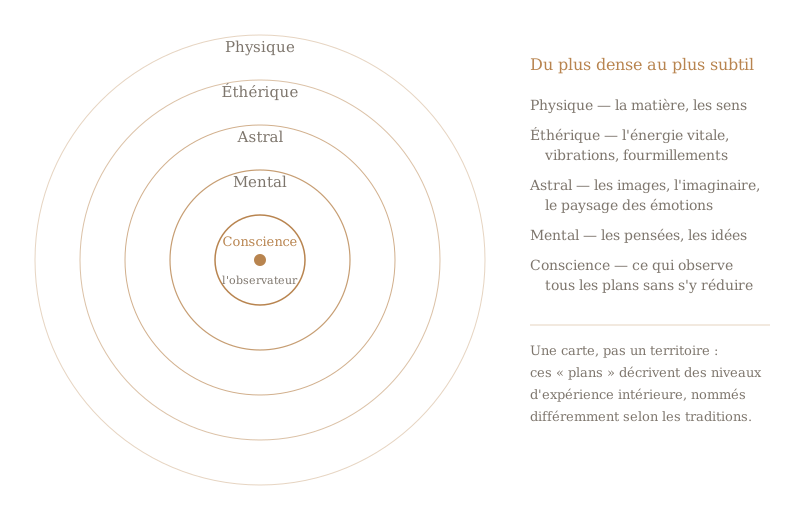
One point needs honesty: these planes are not established facts. No one has measured them. They are phenomenological descriptions — ways of naming levels of experience that meditators and explorers pass through. Like any map, it simplifies. And like any map, it is precious as long as you remember it is not the landscape.
The physical plane — the world of the senses
This is the plane you know: what your five senses report, what can be measured, what resists. On the map it is the densest — not because it is inferior, but because it is the most stable. Everyone sees the same table.
For the explorer it has one function: it is the anchor point. Every return happens here, and it is here that you write down what you experienced.
The etheric plane — the vibrating body
In the tradition, the etheric is the body's "energy double": the life force that animates it, the energy centres (the chakras), the circuits Chinese medicine calls meridians.
None of this has a demonstrated anatomical equivalent. But the experience the word points to is very concrete, and nearly every practitioner knows it: tingling, heaviness, vibrations appearing as the body falls asleep while consciousness stays present.
This is the first stage of every exit. When the protocol talks about "raising the vibration", this is the plane you are working on — whatever explanation you give for what you feel.
The astral plane — the screen of imagination and emotion
Back to the green apple. On the map, the astral plane is where thoughts take form. The mental plane supplies the idea of the apple; the astral gives it an image, a colour, a presence.
The traditions add an essential element: this plane is coloured by emotion. It is often divided into three regions — lower, middle, upper — according to the emotional quality of what forms there. Images born of fear, anger or compulsive desire populate the lower regions. Those born of love, joy and serenity populate the higher ones.
You can read this literally or psychologically. The practical result is the same:
What you meet in the astral resembles what you carry inside.
Practitioners' accounts and lucid dreamers' reports confirm the rule: an unexamined fear becomes a threatening presence; a held-back anger becomes a scene of conflict. Old books spoke of "demons"; many contemporary authors, even esoteric ones, now describe them as thought-forms — emotions we have fed ourselves, which take on a shape.
This is where consciousness exploration meets the heart of stackguru: emotional work is not a detour before the astral, it is the preparation of the astral. Taming your fear, moving through your sadness, understanding your anger — this is literally cleaning the landscape you are about to travel through.
The mental plane — the world of ideas
Beyond images lie formless thoughts: ideas, intuitions, sudden understandings that arrive before words. Some traditions divide it into "concrete" mind (ordinary thoughts) and "abstract" mind (principles, archetypes).
Many esoteric texts claim that thoughts are not produced by the individual but "picked up", the way a radio tunes into a frequency. It is a beautiful, unverifiable image, and you don't need to adopt it. What anyone can verify, however, is that the habitual direction of your attention shapes the kind of thoughts that come to you. The one who ruminates receives ruminations. The one who cultivates curiosity receives questions.
For the explorer, the mind plays a double role. It carries the intention — the direction you set before letting go. And it is also the main obstacle: the analytical chatter that, at the moment of separation, starts commenting ("it's working!") and snaps you straight back into the body.
At the centre: what observes
The most complete maps add, beyond the mental, even subtler planes — buddhic, causal, atmic… — described as formless, contentless, pure presence.
Rather than seeing them as additional floors, we can keep the intuition they point to, shared by Buddhism, Vedanta and Christian mysticism: there is something in you that perceives every plane without being any of them. The body is perceived. The vibrations are perceived. Images, emotions, thoughts are perceived.
Who perceives?
That question is the subject of the article on the meditation of the observer. It is also what this project calls light.
Four practical rules drawn from the map
1. Prepare the plane of arrival before you leave. Your evening emotional state colours what you will meet. A session after an argument is not a good session. Ten minutes of calm and serenity before practice are worth more than an hour of technique.
2. Pass through the etheric without stopping there. Vibrations are a signal, not a destination. Welcome them, don't be frightened by them, don't marvel at them so much that you cling to them.
3. In the astral, thought is an act. What you imagine takes form. If a disturbing image appears, fleeing it often strengthens it; looking at it calmly, or answering it with the opposite emotion, transforms it.
4. Keep the mind on standby, not running. The intention is set beforehand, like a letter dropped in a postbox. During the experience, you observe.
The map of the planes is the legacy of several thousand years of human introspection. It proves nothing. But it orients, it names, it warns against common mistakes. Use it the way a hiker uses a mountain map: checking at every step that it matches what you see.
And on the day it no longer matches, trust the terrain.
Further reading
- Taittiriya Upanishad, II — the doctrine of the five sheaths (koshas).
- H. P. Blavatsky, The Secret Doctrine, 1888 — the theosophical systematisation of the planes.
- C. W. Leadbeater, The Astral Plane, 1895 — one of the first detailed descriptions, to be read with distance.
This site is free and will remain so. If this content has meant something to you, you can support its creation.
Buy me a lucid dreamvia Ko-fi · 100% to the project