The hypnagogic threshold: where the brain opens the door
Every evening, your brain crosses in a few minutes a border zone between waking and sleep. This is where spontaneous images, vibrations and out-of-body experiences are born. Understanding brainwaves means learning to recognise the door.
You have lived this moment without noticing it.
You are in bed, eyes closed. You are still thinking about your day. And suddenly an image appears — an unknown face, a staircase, a sentence that makes no sense. You didn't decide to imagine it. It came on its own. Sometimes a jolt runs through you, as if you were falling. Then you fall asleep, and you have forgotten everything.
This moment has a name: the hypnagogic state. For the explorer of consciousness, it is the most important place of the night. Every technique for leaving the body, for lucid dreaming and for deep meditation tries, one way or another, to enter it without falling asleep.
The brain speaks in waves
Your brain constantly produces electrical activity that can be recorded at the surface of the skull: the electroencephalogram (EEG). This activity oscillates at different frequencies, which researchers have grouped into bands. They are not mutually exclusive — the brain produces several at once — but one dominates depending on your state.
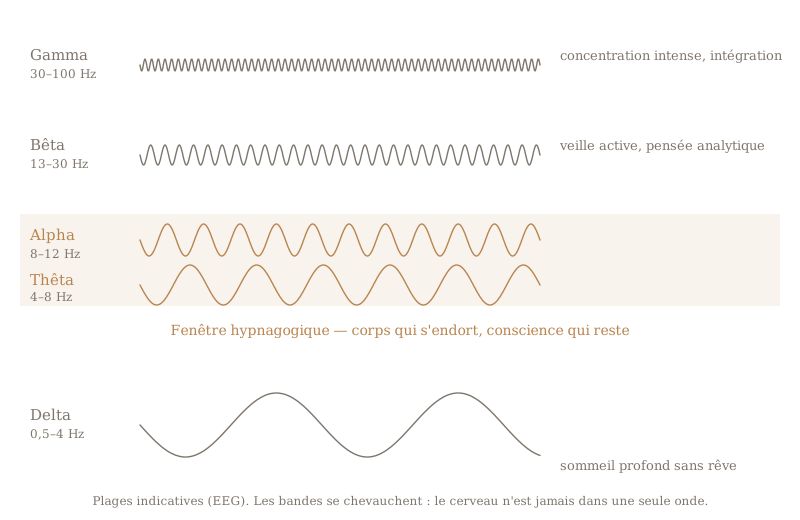
- Beta (13–30 Hz) — active waking. You analyse, plan, talk. This is the state you spend most of your day in.
- Alpha (8–12 Hz) — relaxed waking. It appears as soon as you close your eyes and stop demanding attention. It is the state of daydreaming, relaxation, light meditation.
- Theta (4–8 Hz) — the border. It dominates while falling asleep, during part of REM sleep, and in experienced meditators in deep meditation. It is the band of spontaneous images.
- Delta (0.5–4 Hz) — deep, dreamless, restorative sleep.
- Gamma (30 Hz and above) — often left out of popular diagrams, this band is associated with the integration of information and, remarkably, is found at high levels in some long-term meditators.
Esoteric books often present only four waves and attribute precise powers to them ("in theta, the subconscious is programmable"). Reality is more nuanced: these bands are correlates of states of consciousness, not switches. But the general map is right, and very useful.
What happens at the border
When you fall asleep, the brain does not switch over all at once. It goes through a succession of micro-states that Japanese researchers (Hori and colleagues) described in nine stages: alpha breaks up, fades in waves, theta settles in, sharp waves appear, and then light sleep proper begins.
During this crossing, which lasts from a few seconds to several minutes, everything explorers describe happens:
- spontaneous images, often very sharp, unrelated to your thoughts;
- sounds: voices, buzzing, music, your name being called;
- bodily sensations: heaviness, falling, floating, vibrations, the impression of rolling or tipping over;
- a drop in critical judgement — what is strange seems normal.
Lucid dreamers, out-of-body practitioners and meditators describe exactly the same phenomena. It is no coincidence. They are speaking of the same threshold.
Charles Tart noticed it as early as 1968: during her episodes, his subject "Miss Z" showed a pattern that was neither waking nor ordinary sleep, with a slowed alpha — an in-between state. See Out-of-body experiences: what history has kept.
The explorer's paradox
The hypnagogic threshold poses an obvious difficulty: you cross it by falling asleep. Entering it is enough to lose it.
The whole art therefore lies in keeping a small flame of presence alive — just enough to observe, not enough to wake the body. Too much attention and you stay in beta, awake and frustrated. Too little and you slide into sleep.
Traditions have developed several methods to hold this thread:
The anchor point. Rest gentle attention on a fixed point — the breath, the centre of the chest, the middle of the skull. The protocol uses counting the out-breaths from 1 to 10.
The raised arm. An old technique: fall asleep with your forearm upright, elbow resting on the bed. If you slide too far, the arm drops and wakes you just enough. Thomas Edison and Salvador Dalí used variants (a ball or a key held in the hand) to capture ideas from this state.
Waking in the middle of the night. After four to six hours of sleep, the brain comes back to the surface more easily, and the passage into REM sleep is shorter. This is the "trough of the wave": the threshold there is wider, more stable, more accessible.
The waking dream. Several recent esoteric books describe a simple method: surrender to a reverie, let images flow without directing them for ten to fifteen minutes, until you feel yourself "step out" of present reality. It is a way into alpha-theta without forcing. Its limit: without an anchor point, the reverie turns into sleep.
And Hemi-Sync?
You cannot talk about this threshold without mentioning Robert Monroe. After his own spontaneous experiences, he developed in the 1970s a sound technology called Hemi-Sync ("hemispheric synchronisation"). The principle relies on binaural beats: each ear receives a tone of slightly different frequency — for example 200 Hz on the left and 206 Hz on the right. The brain then perceives a phantom pulse of 6 Hz, the difference between the two.
The idea is that the brain would tune to this pulse and shift into the corresponding state — here, theta. Monroe added that it synchronised the two hemispheres, promoting expanded states of consciousness.
What we know today:
- The perception of binaural beats is a real phenomenon, well known in acoustics.
- The idea that "unsynchronised" hemispheres block meditation, and that Hemi-Sync "harmonises" them, comes from popularisation, not research. The strict "logical left brain / intuitive right brain" split is itself a simplification that neuroscience has largely qualified.
- On the entrainment of brainwaves, results are contradictory. A 2023 systematic review (Ingendoh et al., PLOS ONE) found as many studies failing to confirm it as studies supporting it.
- On the other hand, many practitioners find these recordings useful as an attention support: a regular sound, a frame, a ritual. That is not nothing.
Sensible use: if a binaural recording helps you stay present without getting restless, use it. Listen with headphones, at low volume, lying down. But don't hand the work over to it: sound can accompany the door, it does not cross it for you. And if you are prone to epilepsy, avoid any rhythmic stimulation without medical advice.
A word of caution on "programming"
Some texts claim that, since the brain is in theta on waking and on going to sleep, anything you listen to at those moments "reprograms your DNA". This is not true, and it doesn't need to be.
What is true is simpler: the first and last minutes of the day orient your attention. What you put there — a screen, a worry, or a calm intention — colours your sleep and your dreams. The stackguru protocol uses exactly these moments to set the intention to leave the body. Not as a magic program. As a direction.
Practice: taming the threshold in seven evenings
Before trying to leave, learn to recognise the door.
- Lie on your back, in complete darkness, with no screen for at least thirty minutes.
- Breathe slowly through your nose for two to three minutes, lengthening the out-breath.
- Rest your attention in the centre of your chest. Don't look for anything.
- Watch the darkness behind your closed eyes. After a few minutes, spots, shapes, then images will appear. Don't follow them, don't chase them away.
- Name what you perceive silently, once, without comment: image… sound… heaviness…
- Let sleep come. The exercise is not to stay awake at all costs, but to be present as far as possible.
- In the morning, note in your journal the first images you remember and the moment you "lost the thread".
After a week, you will know the signs of your own threshold. It is the core skill of all exploration. The door opens every evening. You only need to learn to see it.
Further reading
- T. Hori, M. Hayashi, T. Morikawa, "Topographical EEG changes and the hypnagogic experience", in Sleep Onset: Normal and Abnormal Processes, APA, 1994.
- A. Mavromatis, Hypnagogia: The Unique State of Consciousness Between Wakefulness and Sleep, 1987.
- B. K. Ingendoh, E. S. Posny, A. Heine, "Binaural beats to entrain the brain? A systematic review", PLOS ONE, 2023.
- R. Monroe, Far Journeys, 1985.
This site is free and will remain so. If this content has meant something to you, you can support its creation.
Buy me a lucid dreamvia Ko-fi · 100% to the project