The chakras: a map of the subtle body
Seven wheels of light lined up along the spine, each with its colour and its gland. That is the image everyone knows. It is partly ancient, partly very recent. Untangling the two makes the practice more accurate — and freer.
Close your eyes and rest your attention in the centre of your chest. Stay there for a minute.
Something often happens: warmth, pressure, an emotion surfacing, sometimes nothing specific except a denser presence. Do the same at the throat, then at the belly. The sensations are not the same.
The traditions of India gave these places of attention a name: chakra, the "wheel". They drew extraordinarily detailed maps of them. And the West, over the last century, has simplified, coloured and standardised them — sometimes to the point of making them unrecognisable.
Where the chakras come from
The chakras belong to tantra, a set of Hindu and Buddhist traditions that developed in India from around the seventh century. Their central idea: the body is not an obstacle to awakening, but its instrument. They describe a "subtle body" crossed by channels (nadi) and punctuated by centres where energy gathers.
An important and often ignored point: the number of chakras varies from text to text. Some Buddhist texts count four or five. Hindu texts describe six, nine, twelve or more.
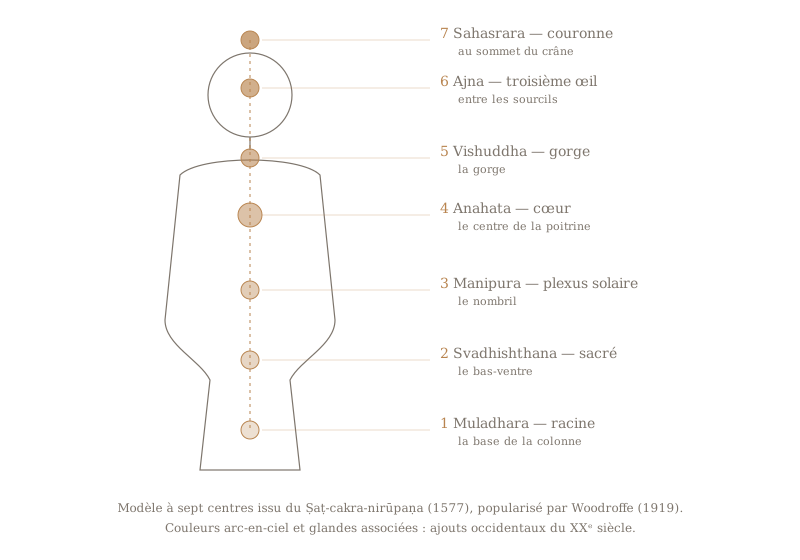
The seven-centre system we know comes mainly from a text of 1577, the Ṣaṭ-cakra-nirūpaṇa ("Description of the six centres"), written by Pūrṇānanda. It describes six chakras along the spine, plus a seventh, the thousand-petalled lotus at the top of the skull. In 1919 the British orientalist John Woodroffe (writing as Arthur Avalon) translated it into English in The Serpent Power. It is through this book that the West discovered the chakras.
What the West added
Three elements of the modern image of the chakras are recent additions.
The colours of the rainbow. In tantric texts each chakra does have a colour, but they do not follow the order red-orange-yellow-green-blue-indigo-violet. This correspondence with the spectrum appeared in twentieth-century Western esotericism, and only became established in its current form in the 1970s.
The endocrine glands. Associating the chakras with glands (thyroid for the throat, adrenals for the solar plexus…) dates from the 1920s. It is appealing, but no study has demonstrated a functional link.
Psychological "vices" and "virtues". Linking each chakra to a life theme — security, sexuality, power, love, expression, intuition, spirituality — is a modern construction, very useful for teaching, but absent from the ancient texts.
Some books go further still: they equate the seven chakras with the seven seals of the Apocalypse, the seven planets, the seven notes, the seven vowels, or calculate their "frequencies in hertz". These correspondences belong to symbolic speculation. They can inspire; they do not describe a mechanism.
What remains, and is precious
Once these layers are removed, a very solid intuition remains — one anyone can check for themselves: attention brought to a region of the body changes how that region is experienced, and some regions are closely linked to emotions.
Research partly confirms this intuition. A now-famous Finnish study (Nummenmaa et al., 2014, PNAS) asked more than 700 people to locate on a silhouette the sensations associated with different emotions. The resulting maps are remarkably consistent across cultures: anger and fear are felt in the chest and upper body, sadness as a slackening of the limbs, love and joy as warmth spreading through the whole body.
This is not proof that chakras exist. It is proof that the body is a living map of the emotions — something the yogis had observed through introspection.
The seven centres as points of attention
Rather than as invisible organs to "unblock", you can use the seven centres as a sequence of attention moving through the body from bottom to top.
- Muladhara — root, at the base of the spine. Contact with the ground, security, the weight of the body.
- Svadhishthana — sacral, the lower belly. Impulses, desire, creativity.
- Manipura — solar plexus, around the navel. Will, the inner "fire", what contracts under stress.
- Anahata — heart, the centre of the chest. Connection, tenderness, sadness too.
- Vishuddha — throat. What is said, what is held back.
- Ajna — between the eyebrows. The inner gaze, concentration.
- Sahasrara — the crown. Openness, silence, what goes beyond the person.
Notice that the four middle centres correspond to places where emotions are concretely felt: the tight throat, the heart that clenches or opens, the knotted stomach. This is where stackguru's emotional work and the chakra map meet.
Practice: the rising of attention
This ten-minute practice can precede a session of the out-of-body protocol: it settles presence in the body before letting it fall asleep.
- Lie down, arms alongside the body. Three slow breaths.
- Bring your attention to the base of the spine. Breathe "into" this area for five breaths. Don't look for anything; observe what is there.
- Move up to the lower belly. Five breaths.
- Then to the navel, the heart, the throat, between the eyebrows. Five breaths at each stage.
- At the top of the skull, let attention open, with no fixed point. Stay there for one or two minutes.
- Note what you noticed: an empty area, a dense area, a surprising emotion. Over time, this record becomes a personal map — the only one that really counts.
Many practitioners report that the vibrations of the separation phase appear more easily after this sequence. Perhaps because attention has learned to inhabit the body from the inside — exactly what tradition called the subtle body.
The chakras are not wheels to spin. They are places to learn to be present.
Further reading
- Pūrṇānanda, Ṣaṭ-cakra-nirūpaṇa, 1577; trans. A. Avalon (J. Woodroffe), The Serpent Power, 1919.
- L. Nummenmaa, E. Glerean, R. Hari, J. Hietanen, "Bodily maps of emotions", PNAS, 2014.
- K. Leland, Rainbow Body: A History of the Western Chakra System, 2016.
This site is free and will remain so. If this content has meant something to you, you can support its creation.
Buy me a lucid dreamvia Ko-fi · 100% to the project