The programs of the subconscious: what can really be rewritten
"The subconscious is 90% of your mind." "Everything is set before the age of seven." "Listen to affirmations on waking and you'll rewrite your DNA." Behind these formulas lies a deep truth about automatisms — and tools that really work.
This morning you brushed your teeth. Do you remember deciding to? Which hand you used, which side you started on?
Probably not. And yet you did it, precisely, as yesterday and the day before. Something in you carried out a complex sequence while your attention was elsewhere.
The two books this journey draws on call these subconscious programs. The image is apt. But in these books, as in many others, it comes with figures and promises that deserve sorting — because here, the truth is more useful than the myth.
What is true: we live largely on autopilot
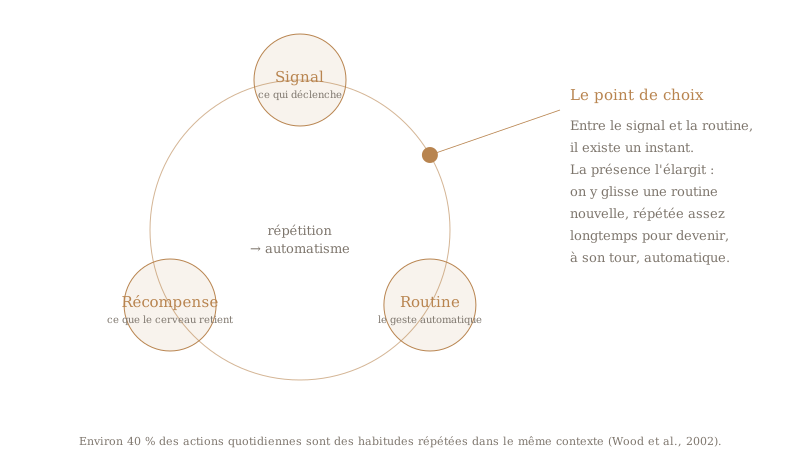
In 2002 the psychologist Wendy Wood and her colleagues asked participants to note, every hour, what they were doing, what they were thinking, and whether they usually did it in the same place. The result: about 40% of daily behaviours were habits — actions repeated almost every day in the same context, often while the mind was thinking about something else.
Forty per cent is enormous. It means that nearly half your day is not decided: it is triggered.
The mechanism is well known. A habit is a three-part loop: a cue (a place, a time, an emotion), a routine (the action), a reward (what the brain registers as pleasant or soothing). Repeated often enough, the loop becomes engraved and runs on its own.
And what holds for actions holds for emotional reactions. A criticism triggers shame; an annoyance triggers anger; an evening alone triggers the screen. These are programs too.
What needs correcting
"The subconscious is 90% (or 95%) of the mind." This figure circulates everywhere; it has never been measured. The mind cannot be cut into percentages. The idea it expresses — most of our functioning escapes consciousness — is right; the figure is decorative.
"Everything is programmed before the age of seven, in theta waves." Childhood is indeed a period of intense learning, and our early years deeply shape our reactions. But the brain remains plastic throughout life. People learn a language, an instrument, a meditation at fifty. Nothing is fixed at seven.
"The subconscious doesn't distinguish between you and others: insulting someone is insulting yourself." No data supports this claim as stated. What is well established, however, is that the way you talk to yourself influences what you feel. Work by Ethan Kross has shown, for example, that talking to yourself in the second person or by your own name ("Lea, you can do this") helps regulate emotions better than "I". Inner language matters.
"Listening to affirmations on waking rewrites your DNA." No. Your DNA does not change. What can change is the direction of your attention, and therefore your behaviour — which is already considerable.
What really can be rewritten
The good news is solid: a program is replaced by another program. You don't remove a habit by willpower. You install a new routine on the same cue, and repeat it.
How long? A University College London study (Lally et al., 2010) followed volunteers installing a new habit (drinking a glass of water at lunch, running before dinner…). The median time for it to become automatic was 66 days, with wide variation — from 18 days to more than eight months. Missing a day did not undermine the process. Regularity mattered more than perfection.
How? The best-documented tool is called the implementation intention, studied since the 1990s by psychologist Peter Gollwitzer. It takes the form: "If [cue], then [new routine]." For example:
- If I go to bed, then I take three slow breaths and set my intention for the night.
- If I feel anger rising, then I place my hand on my chest before answering.
- If I wake up in the night, then I stay still and observe.
Dozens of studies show that phrasing an intention this way clearly increases the likelihood of acting on it. The reason is simple: you prepare the point of choice in advance, instead of relying on willpower at the moment the program fires.
The link with awakening
Spiritual traditions have always known this, in their own words: awakening begins with awareness of automatisms. Buddhism speaks of attention to what arises; Gurdjieff spoke of the "man-machine" who must learn to "remember himself".
In this site's language, the program is what happens before the observer arrives. The more you train what observes, the wider the small moment between cue and routine becomes. And in that moment, you are free.
It is also the key to exploration practice. The out-of-body protocol asks you to cultivate the intention "daily, several times a day". This is not magic: it is exactly how a new program is built. An intention repeated long enough becomes a deep orientation — and ends up firing on its own, at night, at the right moment.
Practice: thirty days for one program
- Choose a single program to replace. Not three.
- Identify its cue: when, where, after what does it fire? Observe it for three days without changing anything.
- Write your intention in the form "If…, then…". One simple, concrete sentence.
- Repeat it morning and evening, under your breath. This is where affirmations find their real place: not to rewrite DNA, but to prepare the point of choice.
- Note each day whether you did it. One lapse is not a failure; two in a row are a signal to simplify.
- After thirty days, notice what has become easy. Then move on to the next one.
You are not your programs. You are what can see them — and therefore change them.
Further reading
- W. Wood, J. M. Quinn, D. A. Kashy, "Habits in everyday life", Journal of Personality and Social Psychology, 2002.
- P. Lally et al., "How are habits formed: Modelling habit formation in the real world", European Journal of Social Psychology, 2010.
- P. M. Gollwitzer & P. Sheeran, "Implementation intentions and goal achievement: a meta-analysis", Advances in Experimental Social Psychology, 2006.
- E. Kross et al., "Self-talk as a regulatory mechanism", Journal of Personality and Social Psychology, 2014.
This site is free and will remain so. If this content has meant something to you, you can support its creation.
Buy me a lucid dreamvia Ko-fi · 100% to the project