As above, so below: what Hermeticism really says
The Emerald Tablet, Hermes Trismegistus, the seven principles of the Kybalion. They are presented as Egyptian wisdom thousands of years old. Their real history is shorter — and their teaching remains one of the finest keys for thinking about the unity of the world.
There is a sentence you find everywhere in spiritual literature. On the walls of lodges, in self-help books, tattooed on forearms, quoted at the start of videos about astral travel:
That which is below is like that which is above, and that which is above is like that which is below.
It is attributed to Hermes Trismegistus, "the thrice-great", a mythical sage of ancient Egypt. It is said to have been engraved on an emerald tablet found in his tomb. Some add that it was written by Thoth himself, thousands of years ago, before being hidden from the masses.
The historical reality is different. It takes nothing away from the power of the sentence. It simply allows us to receive it for what it is — and that is often more useful.
The Emerald Tablet: an Arabic text from the early Middle Ages
The text we call the Emerald Tablet first appears in Arabic treatises, between the seventh and ninth centuries, attributed to a certain "Balinas the Wise" — a pseudonym referring to the Greek philosopher Apollonius of Tyana. The story of its discovery in a tomb is part of the text itself: a literary staging, common at the time, meant to give a writing authority.
In the twelfth century it was translated into Latin by Hugo of Santalla. It then became one of the founding texts of European alchemy. And yes, Isaac Newton did make his own translation: it can be found among his alchemical manuscripts, now kept in Cambridge. The man who formulated the law of gravitation spent a considerable part of his time meditating on these few lines.
What the text is not, however, is an ancient Egyptian writing. And the Emerald Tablets of Thoth the Atlantean, often quoted alongside it, are an entirely different work, published in the 1930s by an American author calling himself Doreal. They have no historical link with the medieval Tablet.
Hermes Trismegistus and the Corpus Hermeticum
Behind the Tablet lies a broader tradition: the Hermetic writings, a collection of philosophical dialogues in Greek composed in Roman Egypt in the first centuries of our era. In them a master, Hermes, teaches his disciples that the universe is the expression of a single Intelligence, and that human beings, by knowing themselves, can rise back towards it.
In the Renaissance these texts caused a sensation. Translated into Latin by Marsilio Ficino in 1471, they were believed to be contemporary with Moses — a primordial wisdom from which all religions sprang. In 1614 the philologist Isaac Casaubon showed, by analysing their vocabulary, that they actually dated from the Christian era.
This is not a fall from grace. These texts remain a remarkable synthesis of Greek philosophy, Egyptian wisdom and the mystical quest of their time. They simply have an age, and a place.
The seven principles: a book from 1908
Most contemporary esoteric works present "the seven universal laws": mentalism, correspondence, vibration, polarity, rhythm, cause and effect, gender. They all come from the same book: The Kybalion, published in Chicago in 1908 by "Three Initiates" — most likely the writer William Walker Atkinson, a figure of the American New Thought movement.
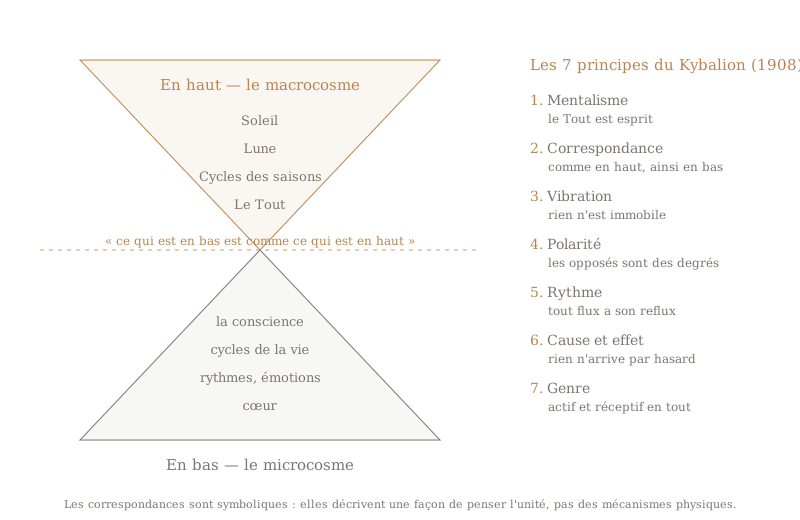
The Kybalion is not a crude forgery. It is a modern, clear and teachable reformulation of ancient intuitions. But it bears the mark of its time: the idea that thought directly shapes reality is closer to American positive psychology than to the dialogues of Hermes.
Knowing them with their date lets you use them with discernment.
What each principle can teach you
Mentalism — "the All is mind". Taken literally, the claim that your thoughts create your reality is unverifiable, and sometimes guilt-inducing ("if you are ill, you must have thought wrongly"). Taken as an orientation, it says something very true: what you perceive of the world always passes through your consciousness. Changing the way you look changes the experience, even when the facts stay the same.
Correspondence — "as above, so below". This is the heart of Hermeticism. The small reflects the great; the inner reflects the outer. The cycles of the seasons resemble the cycles of a life; day and night resemble waking and sleep. It is not a physical law. It is a method of thinking by analogy — that of every mystic, and of many poets.
Vibration — "nothing rests". Physics confirms that matter is made of motion at every scale. But beware of the slide: saying an emotion "vibrates at a higher frequency" is an image, not a measurement. The image is useful for the explorer — the out-of-body protocol speaks of "raising the vibration". It remains an image.
Polarity — "opposites are degrees of the same thing". Hot and cold are two degrees of temperature. Fear and courage, two degrees of the same energy in the face of the unknown. It is one of the most precious keys of emotional work: you don't suppress an emotion, you move it along its axis. Courage is not the absence of fear; it is fear that has changed pole.
Rhythm — "every flow has its ebb". Periods of momentum and periods of lull follow each other. In practice, it is an invitation not to give up during the weeks without results: they are part of the cycle.
Cause and effect — "nothing happens by chance". The careful version: our actions have consequences, often further than we think. The excessive version, to avoid: everything that happens to you is deserved. The first makes you responsible; the second makes you guilty.
Gender — "active and receptive in everything". The 1908 text speaks of "masculine" and "feminine". It is more useful to read active and receptive: the intention that is set and the attention that welcomes. Every practice of consciousness exploration plays on these two poles — willing, then letting go.
A key for the path
Hermeticism gives no information about the world. It gives a posture: that of someone looking for unity behind diversity, who looks at the cosmos to understand themselves, and at themselves to understand the cosmos.
That is exactly the posture of this site. Inner perceptions on one side, rigorous analysis on the other: two movements answering each other, like the above and below of the Tablet.
Above and below are not two worlds. They are two ways of looking at the same light.
Further reading
- J. Ruska, Tabula Smaragdina, 1926 — the study that established the Arabic origin of the Tablet.
- Corpus Hermeticum, ed. A. D. Nock and A.-J. Festugière.
- I. Casaubon, De rebus sacris et ecclesiasticis exercitationes XVI, 1614.
- Three Initiates, The Kybalion, 1908.
- Newton, Keynes MS 28, King's College, Cambridge.
This site is free and will remain so. If this content has meant something to you, you can support its creation.
Buy me a lucid dreamvia Ko-fi · 100% to the project