The Moon and the seven planets: the sky as a language
Seven heavenly bodies, seven metals, seven days of the week. The Ancients read the sky as a mirror of the soul. This symbolic language is very rich — as long as it is not confused with astronomy. And the real Moon does affect our sleep.
Sunday, Monday, Saturday.
Every week, without thinking, you speak the names of the gods of the sky. Sunday, the day of the Sun. Monday, the day of the Moon. Saturday, the day of Saturn. In French the other days carry the rest: mardi for Mars, mercredi for Mercury, jeudi for Jupiter, vendredi for Venus — English replaced them with their Norse equivalents (Tiw, Woden, Thor, Frigg).
This is no accident. For thousands of years humanity watched seven lights moving across the sky among the fixed stars. It called them planets — the "wanderers". And it made them a language for speaking about everything: time, metals, the body, temperaments, the soul.
Seven wanderers
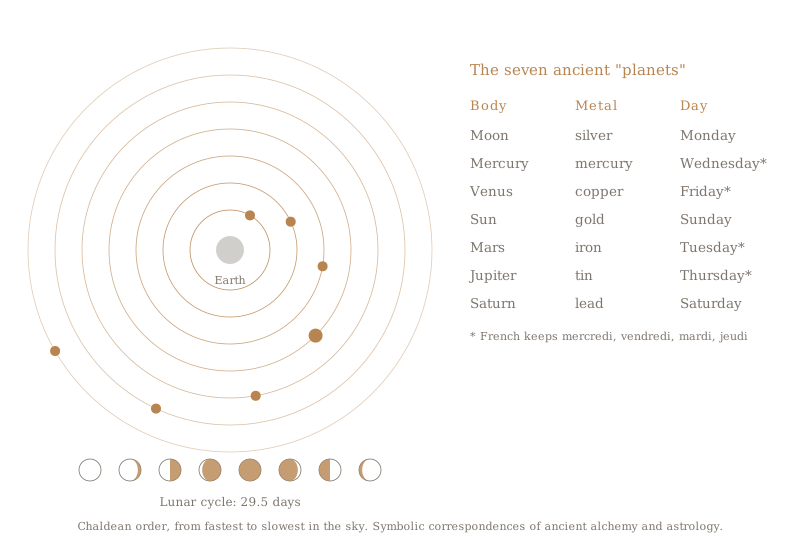
For the astronomers of Babylon and then Greece, the "planets" were seven: the Moon, Mercury, Venus, the Sun, Mars, Jupiter and Saturn. The Sun and Moon were included, because they too move against the background of the stars.
They were ranked by apparent speed, from fastest to slowest: this is the Chaldean order. And each was associated with a metal: silver for the Moon, quicksilver for Mercury, copper for Venus, gold for the Sun, iron for Mars, tin for Jupiter, lead for Saturn. All of alchemy is built on these correspondences.
The inner sky
The books of this journey take up an ancient idea, already found among the Neoplatonists: the seven planets are not only outside, they are also inside. Each represents a quality of consciousness.
- The Moon — reflection, emotions, rhythms, imagination, dreams.
- Mercury — thought, speech, exchange, agility of mind.
- Venus — love, beauty, harmony, connection.
- The Sun — the centre, vitality, self-awareness, what gives life.
- Mars — energy, courage, anger, the capacity to act.
- Jupiter — expansion, generosity, meaning, trust.
- Saturn — limit, structure, time, discipline, melancholy.
Read this way, the system is a symbolic psychology of great subtlety. Saturn, for example, is neither good nor bad: it is form, limit, bone, root — what makes building possible, and what imprisons when it dominates. We find again the pillar of severity of the Tree of Life, or the lead that alchemy seeks to transmute.
What needs correcting
The books this journey draws on sometimes go much further, and some claims must be clearly set aside.
"The planets are not physical; you cannot go there." This is false. Probes have landed on the Moon, Venus and Mars, flown past Mercury, Jupiter and Saturn, and humans have walked on the Moon. The symbolic language does not need to deny astronomy: the two describe different things.
"Saturn is Satan, and the elites worship him in secret." This association belongs to conspiracy theory. It has no place on a path of knowledge.
"The twelve-month calendar was imposed to cut us off from lunar rhythms." A solar year contains about 12.4 lunar cycles (of 29.5 days), not exactly 13. Every culture has had to choose how to reconcile the two; our calendar inherits the Roman calendar, reformed in 1582. No conspiracy there.
The real Moon: what science has measured
While astrology remains a symbolic language, the physical Moon does have measurable effects on life on Earth — and a little on us.
The tides, of course, and the reproductive rhythm of many marine species, such as corals that spawn on full-moon nights.
Sleep. A study published in 2021 in Science Advances (Casiraghi et al.) followed Indigenous communities in Argentina, with and without electricity, as well as students in Seattle. The result: in the days before the full moon, people fall asleep later and sleep less — with variations of 20 to 90 minutes. The effect is stronger without electric light, but persists in the city.
Menstrual cycles. One of the books claims they are naturally aligned with the Moon. A 2021 study (Helfrich-Förster et al.) of women who had kept long-term records of their cycles observed an intermittent synchronisation with certain lunar phases, more frequent in women under 35, and decreasing with exposure to artificial light. The link may exist, but it is weak and variable — far from a universal rule.
Births, emergency room visits, full-moon "madness": many studies have found no effect.
Practice: a month with the Moon
For a full lunar cycle (29.5 days), keep a very simple journal:
- Each morning, note the phase of the Moon (a calendar is enough), the time you fell asleep, the quality of your sleep, and your dreams.
- Each evening, note in one word the dominant emotion of the day, and the planet it corresponds to in the symbolic language: Mars for anger, Saturn for heaviness, Venus for tenderness, Mercury for mental restlessness…
- At the end of the month, reread.
You may notice a link with the Moon, or not. But you will have learned something more valuable: to name your inner states with a rich vocabulary, and to see their cycles. That is exactly what the Ancients did when they looked at the sky.
And for the explorer of consciousness, a practical note: if the full moon shortens your sleep, it also multiplies the awakenings — and therefore the opportunities to work with the trough of the wave.
The sky does not write your destiny. It lends you words to read what is happening inside you.
Further reading
- L. Casiraghi et al., "Moonstruck sleep: synchronization of human sleep with the moon cycle under field conditions", Science Advances, 2021.
- C. Helfrich-Förster et al., "Women temporarily synchronize their menstrual cycles with the luminance and gravimetric cycles of the Moon", Science Advances, 2021.
- F. Cumont, Astrology and Religion among the Greeks and Romans.
This site is free and will remain so. If this content has meant something to you, you can support its creation.
Buy me a lucid dreamvia Ko-fi · 100% to the project