Meridians and qi: the Chinese map of energy
Twelve rivers of energy run through the body, say the Chinese texts, and each has its hour in the day. What traditional medicine really says, what research has found — and what you can keep for your practice.
An acupuncturist places a fine needle on the back of your hand, between thumb and index finger. And you feel something elsewhere — a radiating heaviness, a spreading warmth, sometimes a sudden release in the neck.
For Chinese medicine there is nothing strange in this. That point, called Hegu, lies on a meridian — a channel through which qi, vital energy, flows. The whole body would be crossed by these invisible rivers, connected like the waterways of a country.
One of the books of this journey describes the twelve main meridians and their pathways. It is a magnificent map, more than two thousand years old. It deserves to be understood for what it is.
A two-thousand-year-old map
The founding text is the Huangdi Neijing, the "Inner Classic of the Yellow Emperor", compiled between the second and first centuries BCE. It describes the body as a landscape: qi flows through it like water, gathers, overflows, stagnates. Health is a balance between yin (what receives, cold, the interior) and yang (what acts, warmth, the exterior).
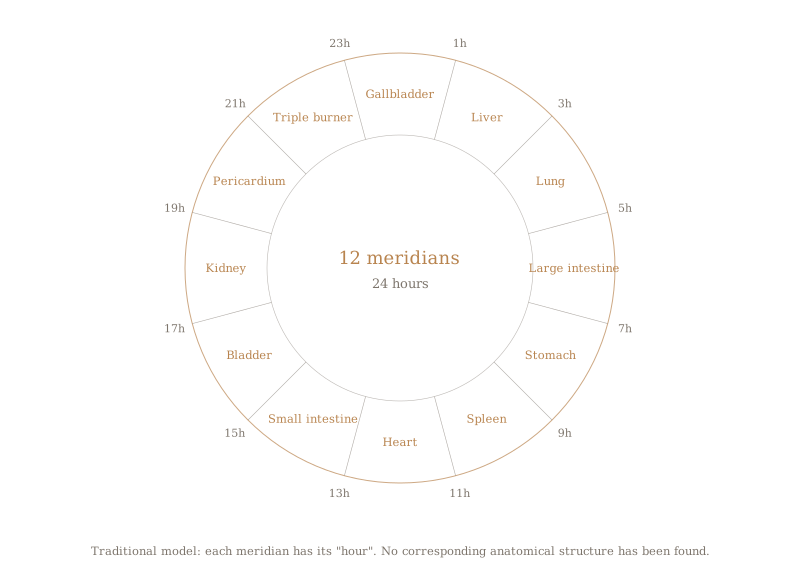
The twelve main meridians are named after an organ — lung, large intestine, stomach, spleen, heart, small intestine, bladder, kidney, pericardium, "triple burner", gallbladder, liver. But "organ" must be understood in the Chinese sense: a function, a set of qualities, not only the anatomical part. The "kidney" is also associated with fear and willpower; the "liver" with anger and drive.
The tradition also describes a clock: qi is said to pass through each meridian for two hours, circling the body in twenty-four hours.
What research has found
No anatomical meridians. Despite extensive research — dissection, imaging, electrical measurements of the skin — no physical structure corresponding to the meridians has been found. No vessel, no nerve, no channel of their own. Qi has no measurable equivalent in physics.
But acupuncture is not without effect. For some chronic pain (back, neck, osteoarthritis, headaches), large meta-analyses covering tens of thousands of patients (Vickers et al., 2012 and 2018) show that acupuncture does better than no treatment, and slightly better than "sham" acupuncture. The difference from placebo exists, but it is modest. A large part of the effect comes from the ritual, attention, relationship and touch — which is not nothing.
The body's rhythms are real. The idea that the body changes over twenty-four hours is confirmed by chronobiology: temperature, hormones, alertness and digestion follow a circadian rhythm. The details of the Chinese clock (the liver active between 1 and 3 am, for example) are not validated; the general intuition is.
This double finding matters. The map is not anatomy. But it is not empty either. It encodes two thousand years of careful observation of the living body: where tension builds up, where emotion settles, how a person's energy varies through the day.
What the book says, and what we keep
One of the books claims that qi "comes from the etheric body" and that the meridians are its expression. This is a fusion of Chinese medicine with Western Theosophy — two systems that did not know each other. You may find the analogy evocative: the qi of China, the prana of India, the "etheric" of the Theosophists all point to the experience of the living, animated, vibrating body. But they are not three names for one demonstrated substance.
What we keep for consciousness exploration:
- the body is a map of sensations, and attention can travel through it (see the chakras);
- emotions have a bodily geography, which Chinese tradition mapped in its own way;
- timing matters: energy is not the same at 7 am and at 3 am — which is precisely what the trough of the wave exploits.
Practice: tapping the meridians
A simple practice from Chinese energy exercises (daoyin, qigong), for three minutes in the morning.
- Stand, feet hip-width apart, knees soft.
- With the palm of your right hand, gently tap the inside of your left arm, from the shoulder down to the thumb (the traditional path of the lung meridian), then go back up along the outside of the arm, from the back of the hand to the shoulder. Three times. Change sides.
- With both hands, tap the outside of the legs from the hips down to the ankles, then back up along the inside. Three times.
- Finish by placing both hands on the lower belly, below the navel — the dantian of the tradition. Three slow breaths.
Then notice the overall sensation of the body: often more warmth, presence, tingling. You don't need to believe in qi to notice that your body feels more inhabited. That is exactly the state every exploration starts from.
The meridian map is not a photograph of the body. It is the memory of two thousand years of attention paid to it.
Further reading
- Huangdi Neijing (Inner Classic of the Yellow Emperor), 2nd–1st century BCE.
- A. J. Vickers et al., "Acupuncture for chronic pain: individual patient data meta-analysis", Archives of Internal Medicine, 2012; updated in The Journal of Pain, 2018.
This site is free and will remain so. If this content has meant something to you, you can support its creation.
Buy me a lucid dreamvia Ko-fi · 100% to the project