Mudras: the language of the hands
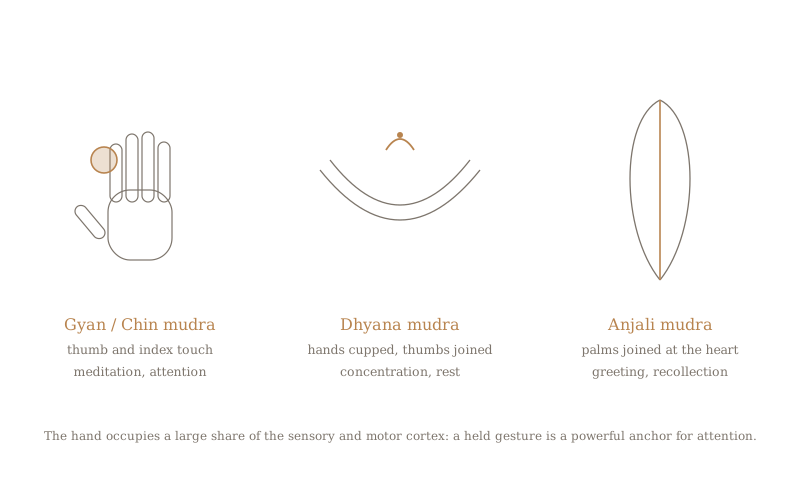
The meditating Buddha, hands cupped. The thumb touching the index finger. Palms joined before the heart. Mudras are gestures thousands of years old. They do not heal organs, as you sometimes read — but they do something simpler and very real.
Look at a statue of the Buddha. Before you even see the face, you notice the hands. Resting cupped on the knees. Or the right hand touching the earth. Or the palm raised towards you, as if to say: do not be afraid.
These gestures have a name: mudra, a Sanskrit word meaning "seal". A seal is what imprints a form and keeps it closed. A beautiful idea: a gesture that seals an inner state.
Recent esoteric books turn them into healing tools: this mudra "detoxifies", that one "strengthens the bones" or "activates the organs". Reality is more modest, and more interesting.
Where mudras come from
Mudras appear in three great traditions of India.
Buddhist and Hindu iconography. Each gesture of the statues has a codified meaning: dhyana mudra, hands cupped, for meditation; abhaya mudra, palm raised, for protection; bhumisparsha mudra, hand touching the ground, for the Buddha's awakening as he calls the Earth to witness.
Dance and theatre. The Natyashastra, the Indian treatise on the performing arts written some two thousand years ago, describes dozens of hand gestures that tell a story: a bird, a lotus, an emotion. Classical Indian dance still uses them.
Yoga. In hatha yoga texts (fifteenth to seventeenth centuries), "mudras" mostly refer to postures and contractions of the whole body, not just hand gestures. The hand mudras taught in the West today are a simplified selection from this richness.
What needs correcting
One of the books presents the body as "an electrical computer" whose hands are "circuits" connected to every organ, and claims that holding a mudra triggers healing processes: digestion, detoxification, bone strengthening.
No study demonstrates these effects. There is no direct connection between a finger and an organ. Presenting a gesture as a treatment can even be harmful if it diverts someone from necessary care.
The other book proposes a correspondence between each finger and a chakra, and another between each toe and a chakra. These are modern symbolic systems, among others, which contradict each other from one author to the next.
What is true, and precious
The hand is huge in the brain. On the map of the motor and sensory cortex — what neurologists call the homunculus — the hand and fingers occupy a disproportionate area, comparable to the whole face. We perceive our hands with extreme precision.
A very concrete consequence: a hand gesture, held with attention, is a powerful anchor. The contact of thumb and index, for example, creates a precise, constant sensation that is easy to return to. When the mind wanders, you simply come back to that point of contact.
Gesture influences state. Research on "embodiment" shows that postures and gestures colour emotions and the way we perceive ourselves. The results are nuanced, and some spectacular effects announced in the 2010s have not been replicated. But the general idea — the body is not merely a servant of the mind, it takes part in the inner state — is widely accepted.
Gesture is ritual. Joining your hands before meditating signals to your whole system: now, I am changing state. With repetition, this signal becomes a real program: the gesture alone is enough to trigger calm.
Three mudras for practice
Gyan (or Chin) mudra — attention. The tip of the thumb touches the tip of the index finger; the other three fingers stay relaxed. The hands rest on the thighs, palms up or down. It is the classic gesture of seated meditation. Use the point of contact as an anchor: every time you get lost in thought, return to the sensation of the two fingers.
Dhyana mudra — recollection. The right hand rests in the left, palms up, cupped, at the level of the belly; the thumbs touch lightly, forming an oval. A valuable clue: if the thumbs separate, you are falling asleep; if they press together, you are forcing. The gesture tells you about your state.
Anjali mudra — greeting. Palms joined before the heart. A greeting in India (namaste), a gesture of prayer elsewhere. It brings attention back to the centre of the chest, where the coherent heart comes into play. Perfect for opening or closing a practice.
Practice: sealing the passage
Before a session of the out-of-body protocol:
- Sit on the edge of the bed. Join your hands in Anjali mudra. Three slow breaths. State your intention.
- Lie down. Form a Gyan mudra with each hand, resting alongside the body.
- During stasis, keep light attention on the points of contact of the fingers.
- When the sensations in the hands fade — when you no longer really feel where your fingers are — it is often the sign that the body is falling asleep while consciousness remains. The gesture has become your witness.
A gesture does not heal an organ. It reminds the mind where to settle.
Further reading
- Natyashastra, attributed to Bharata Muni (between the 2nd century BCE and the 2nd century CE).
- Hatha Yoga Pradipika, 15th century, chapter III (the mudras).
- W. Penfield & T. Rasmussen, The Cerebral Cortex of Man, 1950 — the cortical homunculus.
This site is free and will remain so. If this content has meant something to you, you can support its creation.
Buy me a lucid dreamvia Ko-fi · 100% to the project