What the senses perceive: the world your brain builds
You believe you see the world as it is. In fact your brain predicts it, then corrects its prediction with what the senses bring. From Plato's cave to neuroscience, the first threshold is perception.
Look around you. The room, the colours, the sounds, the weight of your body on the chair. It all seems simply there, given, obvious.
Yet nothing you perceive reaches you directly. Light stops at your retina. Sound stops in your inner ear. What reaches the brain are electrical signals — impulses in nerve fibres, without colour, without music, without warmth. And yet you live in a world that is coloured, sounding, warm.
The two books of this journey say it in their own way: "everything we perceive is an interpretation by the brain". This is the first threshold. And probably the most important one to understand before all the others.
An ancient intuition
Twenty-four centuries ago, Plato imagined prisoners chained at the back of a cave, their backs to the entrance. They see only shadows cast on the wall, and take them for reality. The day one of them breaks free and goes out, the light first blinds him — then he discovers that the shadows were only reflections (Republic, Book VII).
In India, the Vedantic tradition speaks of maya: not that the world is false, but that our ordinary perception veils it, cutting it up into separate objects.
In the nineteenth century, the German physicist and physiologist Hermann von Helmholtz put forward an idea that would go far: perception is an unconscious inference. The brain does not receive the world; it guesses it from clues.
The predictive brain
Contemporary neuroscience has greatly developed this idea. According to the predictive brain model, the brain does not merely process what comes in. It constantly generates predictions about what it is about to perceive, and compares them with signals from the senses. Only the gap — the "prediction error" — really travels upward and is used to correct the model.
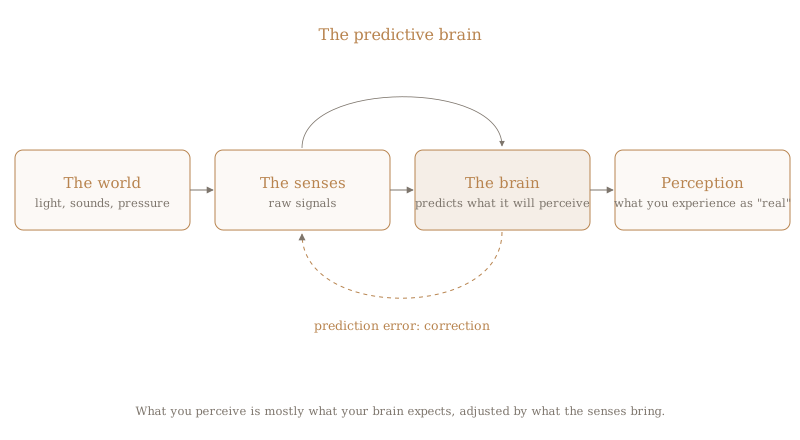
A few simple experiences show it:
- The blind spot. Each eye has an area without receptors, where the optic nerve leaves. You don't see a hole in your field of vision: the brain fills it in.
- Optical illusions. Two lines of the same length look different depending on the arrows at their ends. Knowing they are equal is not enough to see them as equal: the prediction is stronger than the knowledge.
- The misspelled word you read correctly without noticing the mistake.
None of this means the world does not exist. It means that what you experience is always a construction — faithful, useful, but constructed.
Why this is a threshold
This understanding deeply changes how we approach experiences of consciousness.
It explains altered states. When signals from the senses weaken — in darkness, stillness, falling asleep — the brain keeps predicting, but with fewer corrections. Hypnagogic images, floating sensations and the vibrations of the sleep threshold appear precisely there.
It calls for caution. If the brain can produce very convincing perceptions without outside signals, then an intense experience is not, by itself, proof of what it seems to show. Researchers who study out-of-body experiences know this: that is why they hide targets to be identified.
It opens a freedom. If your perception is a construction, it can be trained. Meditators who observe their sensations at length describe a finer, fresher perception, less covered with labels. That is exactly the aim of the meditation of the observer: to see what is there before the mind names it.
What the books say, and what we keep
One of the books links each of the five senses to a part of the Eye of Horus symbol, and sees the body as "a computer that simulates reality". The first correspondence is a modern, unverifiable interpretation of the Egyptian symbol; the second is a metaphor, not a scientific description.
What we keep is the essential, and it is dizzying: the world you live in is partly woven by your consciousness. Not in the sense that you could change it by thought, but in the sense that the way you look shapes what you see.
Practice: unlearning to see
A ten-minute practice, inspired by painters and contemplatives alike.
- Choose an ordinary object: a cup, a leaf, your hand.
- For two minutes, look at it as if you did not know what it was. Don't name it. Observe shapes, shadows, reflections, nuances.
- Notice the moment the word comes back ("cup") and the gaze closes. Gently return to seeing without a name.
- Do the same with a sound: listen to it without identifying it, as pure vibration.
- Then close your eyes, and observe what your brain keeps producing in the dark.
With repetition, you will feel a subtle difference between seeing and recognising. That small gap is the first crack in the wall of the cave.
You do not see the world as it is. You see it as you are — and you can learn to see differently.
Further reading
- Plato, Republic, Book VII — the allegory of the cave.
- H. von Helmholtz, Treatise on Physiological Optics, 1867 — unconscious inference.
- A. Clark, Surfing Uncertainty: Prediction, Action, and the Embodied Mind, Oxford University Press, 2016.
- A. Seth, Being You: A New Science of Consciousness, 2021.
This site is free and will remain so. If this content has meant something to you, you can support its creation.
Buy me a lucid dreamvia Ko-fi · 100% to the project