The inner paradise: rereading sin, heaven and hell
The Greek word translated as "sin" first means "to miss the mark". And for many mystics, heaven and hell are also states we pass through in this life. A rereading that frees from guilt without removing any of the demand.
Some words weigh heavily. Sin, hell, damnation. For many, they evoke fear, shame, an outside judge counting faults.
The two books of this journey propose rereading them differently: sin as an error of direction, heaven and hell as inner states. This is not a modern invention. This reading has ancient roots, in the very text of Scripture and in many mystics. It deserves to be presented with care — and with respect for those who believe otherwise.
Hamartia: missing the mark
In the New Testament, written in Greek, the word translated as "sin" is hamartia. It comes from the verb hamartanein, which first means "to miss the mark" — the archer whose arrow goes wide of the target. Homer uses it for a warrior whose spear fails to reach his opponent. Aristotle uses it for the hero's tragic error.
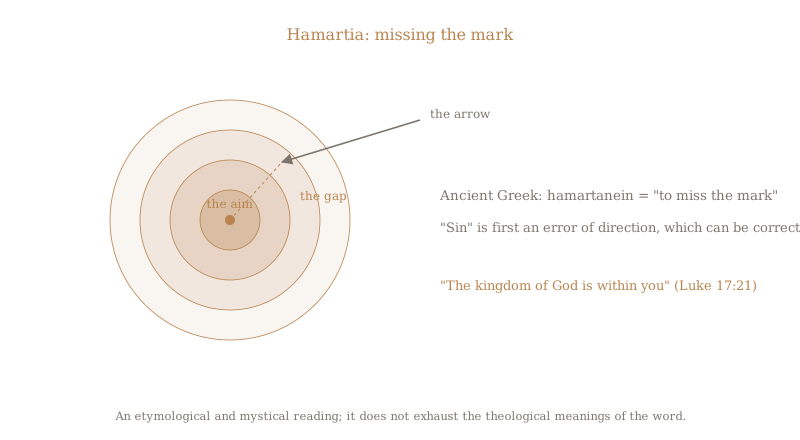
This image changes everything. An archer who misses the target is not a monster. He needs to adjust his aim. Error is not an identity; it is a gap, which can be corrected.
This is exactly the distinction psychology makes between shame ("I am bad") and guilt ("I did something bad"). The first crushes; the second allows repair. Research by June Tangney and colleagues shows that repair-oriented guilt fosters empathy and change, whereas shame leads to withdrawal or aggression. The article on shame develops this.
Theologians will rightly point out that in Christian tradition the word took on a broader meaning: a broken relationship, not just a missed shot. The etymological reading does not exhaust the meaning; it lights up one side of it.
"The kingdom is within you"
In the Gospel of Luke (17:21), Jesus says the kingdom of God does not come in an observable way, for it is entos hymōn — a Greek expression translated sometimes as "within you", sometimes as "among you". Both translations are defended by scholars.
The inner reading has a long history. In the third century, Origen already interpreted it this way. Tolstoy made it the title of a book in 1894. The Rhineland mystic Meister Eckhart, in the fourteenth century, spoke of a "ground of the soul" where God is ceaselessly born.
The books of this journey go in this direction: heaven would be the state of peace and unity that appears when the mind falls silent; hell, the prison of thoughts and emotions going round in circles. Eastern traditions say similar things: in Buddhism, the "realms" of existence are also read as states of mind we pass through several times a day.
This reading obliges no one to give up faith in a hereafter. It adds a dimension: heaven and hell begin here, in the quality of consciousness.
Inner states, day to day
Taken this way, these old words become tools for observation.
- Hell: rumination, cherished resentment, fear going round in circles. What the map of the planes calls the lower regions of the astral.
- Purgatory: the moment you finally look at what hurts, and it burns a little — emotional work itself.
- Heaven: moments of presence, gratitude, love without calculation. What meditators describe, and many witnesses of near-death experiences.
And "sin" becomes a simple question, asked without shame: where did my arrow go today? How can I adjust my aim?
What to set aside
One of the books claims that religions were deliberately "externalised" by elites to keep the masses in ignorance. This is a conspiracy-style claim with no historical basis. Religious traditions have always carried both outer and inner readings, literal and symbolic, often within the same communities. Christian, Jewish and Muslim mysticism were born at the heart of institutions, not against them.
Practice: adjusting the aim
A five-minute exercise for the evening.
- Sit down, close your eyes, three slow breaths.
- Find one moment in the day when you "missed the mark": a word too harsh, an absence, impatience.
- Notice the difference between "I did that" and "I am like that". Choose the first sentence.
- Ask yourself: what was my real aim at that moment? (to be respected, understood, to protect someone…)
- Formulate one concrete adjustment for tomorrow. A single sentence.
- Finish with a moment of "heaven": a simple memory of peace or gratitude, held for ten seconds.
You are not your error. You are the archer, and the target is still waiting for you.
Further reading
- Gospel of Luke 17:20-21.
- J. P. Tangney & R. L. Dearing, Shame and Guilt, Guilford Press, 2002.
- Meister Eckhart, Sermons and Treatises.
- L. Tolstoy, The Kingdom of God Is Within You, 1894.
This site is free and will remain so. If this content has meant something to you, you can support its creation.
Buy me a lucid dreamvia Ko-fi · 100% to the project