Lucid dreaming: waking up inside the dream
Knowing you are dreaming, while you dream. Long considered a legend, lucid dreaming was demonstrated in the laboratory in the 1980s — and in 2021 researchers even held a dialogue with sleeping dreamers. It is the best-documented cousin of the out-of-body experience.
You are walking down a street you don't know. Something is off: signs change when you read them again, light comes from nowhere. And suddenly, a clear thought: I am dreaming.
Everything changes. Colours become brighter. You feel your dream body sharply. You know your real body is lying somewhere, asleep — and yet you are fully there, conscious, free.
This is a lucid dream. The books of this journey describe dreaming as a moment when "the mind projects the soul into another reality while the body rests". Whatever interpretation you keep, the lucid dream is where that idea becomes an experience you can learn, and verify.
A very old experience
Aristotle, in the fourth century BCE, already noted that "often, when one is asleep, there is something in consciousness which declares that what then presents itself is but a dream". In Tibetan Buddhism, dream yoga (milam) has for centuries taught people to recognise the dream as a dream, then to practise meditation within it. In 1867, the Marquis Hervey de Saint-Denys published in France Dreams and How to Guide Them, the fruit of twenty years of dream journals.
The term "lucid dream" itself comes from the Dutch psychiatrist Frederik van Eeden, in 1913.
Proof in the laboratory
For a long time, science doubted. How can you prove that someone is conscious while asleep?
The answer came from a detail: during REM sleep, the body is paralysed — except the eyes. In 1975 the British psychologist Keith Hearne, then in 1980–81 Stephen LaBerge at Stanford University, had the same idea: ask dreamers, before falling asleep, to make an agreed signal with their eyes as soon as they became lucid — for example left-right, left-right.
The recordings showed it unambiguously: in the middle of REM sleep, confirmed by the electroencephalogram, the signal appeared. The dreamer was conscious, and made it known from inside the dream.
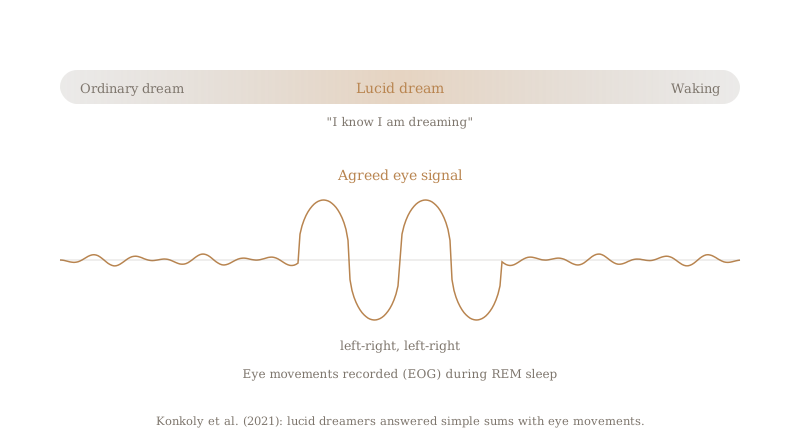
In 2021, an international study published in Current Biology (Konkoly et al.) went further. In four laboratories (United States, France, Germany, the Netherlands), researchers asked lucid dreamers questions during their dreams — for example "eight minus six?" — by speaking to them or using light signals. The dreamers answered with eye movements. Out of 158 attempts, about 18% received a correct answer: few, but enough to establish that dialogue is possible.
What we know today
- It is common. A meta-analysis (Saunders et al., 2016) estimates that about one person in two has had at least one lucid dream, and about one in five has one at least once a month.
- The brain changes. During lucidity, certain frontal regions — associated with reflective awareness — partly reactivate, whereas they are usually quiet during dreams.
- It can be learned. Several techniques clearly increase the frequency of lucid dreams, especially when combined.
Lucid dreaming and out-of-body experiences
The two experiences are very similar, and practitioners often move from one to the other. Both occur during the same sleep phases, often at the same time: after four to six hours of sleep, in what the out-of-body protocol calls the trough of the wave.
The difference lies mainly in the entrance. In a lucid dream, you start from the dream and become conscious within it. In an out-of-body experience, you start from waking and keep consciousness while the body falls asleep. The inner landscape is often comparable.
For many explorers, lucid dreaming is the easiest door. And it is excellent training for what matters most: staying present while the body sleeps.
Practice: three proven techniques
1. The dream journal. Every morning, before moving, write down everything you remember. Even a fragment. In two or three weeks dream recall improves markedly — and you start to spot your recurring "dream signs" (places, people, impossible situations).
2. The reality check. Several times a day, sincerely ask yourself: am I dreaming? Then check: read a text twice (in a dream it often changes), look at your hands, try to breathe while pinching your nose. The habit ends up being repeated in the dream, the test fails — and you become lucid.
3. MILD (mnemonic induction, developed by LaBerge). On waking after four to six hours of sleep, stay awake for a few minutes. Recall the dream you just had. Then, as you fall back asleep, repeat the intention: next time I dream, I will know I am dreaming. Imagine yourself in the dream, recognising it as a dream. It is, in another form, the implementation intention: "if I dream, then I notice it".
A caution: if lucid dreams disturb your sleep or become distressing, take a break. Restorative sleep comes before exploration.
The dream does not become real when you are lucid. You become real in the dream.
Further reading
- S. LaBerge & H. Rheingold, Exploring the World of Lucid Dreaming, 1990.
- K. R. Konkoly et al., "Real-time dialogue between experimenters and dreamers during REM sleep", Current Biology, 2021.
- D. T. Saunders et al., "Lucid dreaming incidence: a quality effects meta-analysis of 50 years of research", Consciousness and Cognition, 2016.
- Hervey de Saint-Denys, Dreams and How to Guide Them, 1867.
This site is free and will remain so. If this content has meant something to you, you can support its creation.
Buy me a lucid dreamvia Ko-fi · 100% to the project