Death and near-death experiences
A tunnel, a light, departed loved ones, a life passing before your eyes. Thousands of people who came back from cardiac arrest report strikingly similar experiences. What medicine has measured, what it cannot explain, and what these accounts change for the living.
"Death is not the end of life," writes one of the books of this journey. Sleep, it adds, is "the cousin of death": every night we cross a small version of the great passage.
It is a very old intuition. The Greeks made Hypnos, sleep, the twin brother of Thanatos, death. The Tibetan Book of the Dead teaches that the states passed through after death resemble those of dreaming and deep meditation.
But today there is more than intuition. There are testimonies, collected by doctors, in hospitals, from patients whose hearts had stopped.
This text deals with death. If you are grieving or going through a hard time, take it at your own pace. And if you are having dark thoughts, talk to someone you trust or to a professional.
What those who came back report
A near-death experience (NDE) is a set of perceptions reported by people who have been close to death — most often during cardiac arrest. The term was popularised in 1975 by the American physician Raymond Moody (Life After Life).
The first large prospective study was published in 2001 in The Lancet by the Dutch cardiologist Pim van Lommel. His team systematically interviewed 344 patients resuscitated after cardiac arrest, in ten hospitals. The result: 62 of them, or 18%, reported a near-death experience.
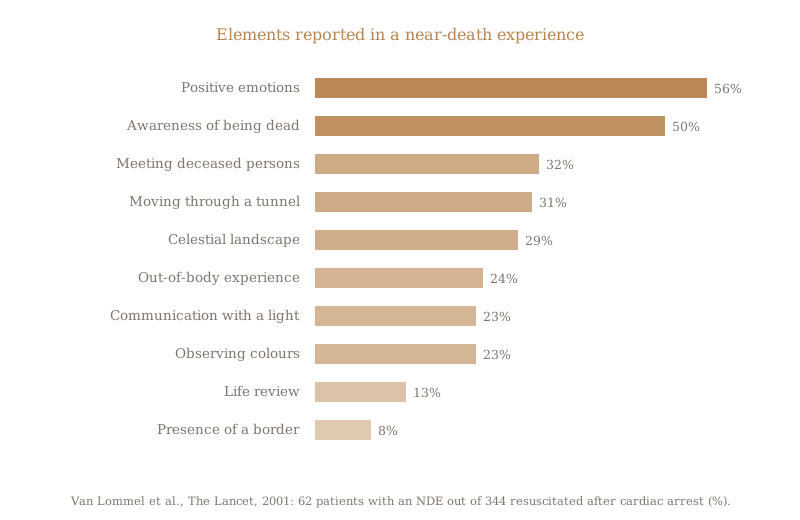
What is striking is the regularity of these accounts, from one person to another, from one country to another: a feeling of deep peace, awareness of being dead, sometimes perceiving the scene from above the body, a passage, a light of indescribable quality, departed loved ones, a review of one's life, and a limit beyond which there would be no return.
Equally striking are the lasting effects. Van Lommel saw the patients again two years and eight years later. Those who had had an NDE were on average less afraid of death, gave more importance to love and compassion, and less to material things.
What medicine has measured since
In 2023 the AWARE II study, led by Dr Sam Parnia and published in the journal Resuscitation, followed 567 patients in cardiac arrest in 25 hospitals, mainly in the United States and the United Kingdom. Fewer than 10% survived to hospital discharge. Among the survivors interviewed, about four in ten remembered some form of consciousness during resuscitation.
More surprising still: in some patients whose brain activity was recorded during resuscitation, near-normal brain waves — including gamma waves associated with conscious thought — sometimes reappeared up to an hour after chest compressions began.
The explanations under debate
Honesty requires saying it: no one today can fully explain NDEs. Several hypotheses coexist.
Neurological hypotheses. Lack of oxygen, excess carbon dioxide, the release of endogenous substances, or a sudden burst of electrical activity in the dying brain could produce these experiences. We know, for example, that stimulating certain brain regions can cause a sensation of leaving the body (Blanke, 2002). These explanations account for some elements, but not all: they struggle to explain the clarity and coherence of memories formed at a time when the brain is functioning poorly.
The hypothesis of a consciousness not reducible to the brain. Some researchers, including van Lommel, believe these experiences suggest that consciousness is not entirely produced by the brain. This is the thesis presented in Exploring consciousness: the brain as a filter rather than a source.
The cases in which a patient accurately describes events that occurred during their cardiac arrest are the most debated. Some seem remarkable; none has yet been verified under the strict conditions the AWARE studies attempted to set up (hidden images, visible only from the ceiling).
This site does not settle the question. It asks it, and it deserves to be asked.
What these accounts change for the living
Whatever their nature, NDEs teach something concrete to those who have not had them.
The fear of death can be transformed. Almost all witnesses say it: they are no longer afraid. Ancient philosophers, the Stoics in particular, recommended meditating regularly on death — not to grow sad, but to live better.
The life review questions our priorities. Those who have experienced it say you do not see your successes again, but the way you loved and the way you caused suffering.
The light comes back everywhere. In NDEs, in the traditions, in this site's mantra. It will be the subject of the last step of this journey.
Practice: the evening review
Inspired both by accounts of "life review" and by the evening examination of the Stoics and the contemplative traditions.
- In the evening, lying down, go over your day backwards, from bedtime to waking.
- For each important moment, don't judge. Simply observe: what did the other person feel?
- Find a moment when you gave love, however tiny. Let gratitude come.
- Find a moment when you lacked fairness. Simply set the intention to act differently tomorrow.
- Finish with three slow breaths, and let the day close.
Practised regularly, this review lightens the heart — and prepares a peaceful falling asleep, ideal for any exploration.
Those who came back do not say "I saw death". They say "I understood what living was".
Further reading
- P. van Lommel et al., "Near-death experience in survivors of cardiac arrest: a prospective study in the Netherlands", The Lancet, 2001.
- S. Parnia et al., "AWARE-II: a multicentre study of consciousness and awareness of death during cardiac arrest", Resuscitation, 2023.
- R. Moody, Life After Life, 1975.
- Bardo Thödol (The Tibetan Book of the Dead), trans. W. Y. Evans-Wentz, 1927.
This site is free and will remain so. If this content has meant something to you, you can support its creation.
Buy me a lucid dreamvia Ko-fi · 100% to the project